Cloudflare workerd Runtime Analysis: A Guide to the Server-Side JavaScript/Wasm Environment

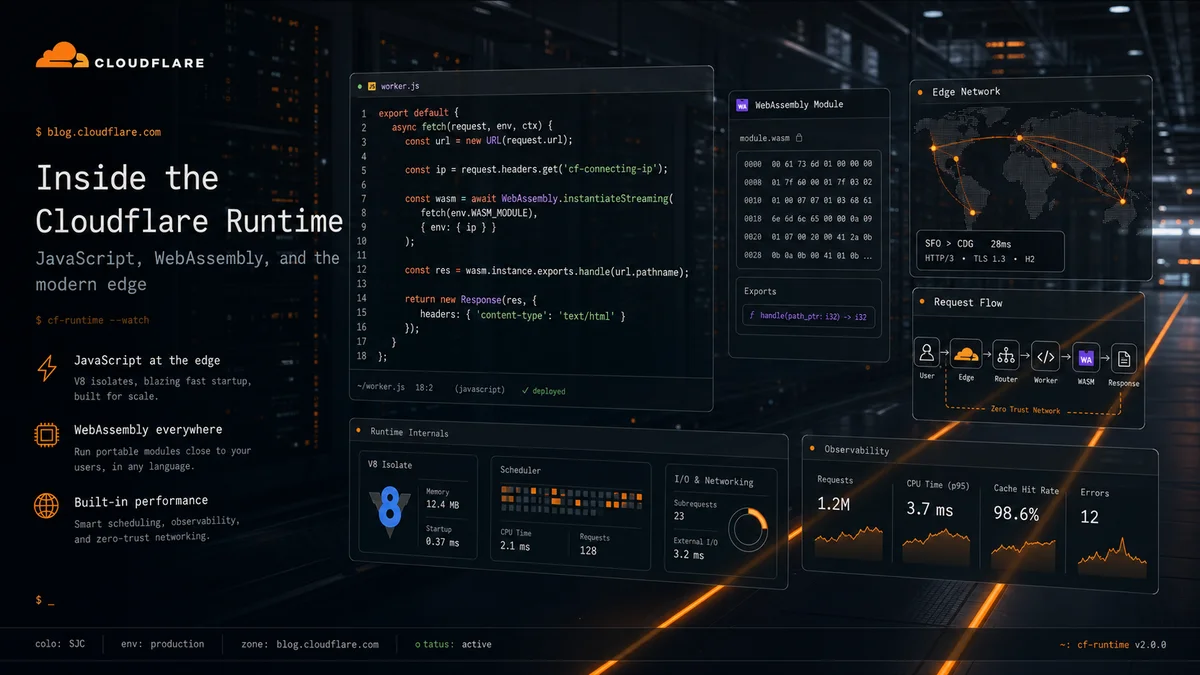
Cloudflare's open-source project workerd is a server-side JavaScript/Wasm runtime derived from the same codebase that powers Cloudflare Workers. The repository documentation presents three main use cases: self-hosting as an application server, use as a local development tool, and use as a programmable forward or reverse HTTP proxy. Its design philosophy emphasizes server-first operation, compliance with web standards such as fetch(), a high-performance nanoservices architecture, and a configuration-driven capability-binding model.
The design principles and their practical implications can be summarized as follows:
- Server-first: workerd is designed primarily for long-running operation and multiple services in server environments rather than for a CLI or GUI. This is reflected in operational and deployment patterns such as systemd integration.
- Standards-based APIs: the runtime provides built-in APIs that follow web-platform standards, such as
fetch(), aiming for high compatibility with existing Workers code. - Nanoservices: components are smaller and lighter than microservices and are designed to achieve local-function-call performance when invoked in the same process and thread.
- Homogeneous deployment: deploying every nanoservice to every node reduces load-balancing and deployment complexity.
- Capability bindings: a configuration file uses capability bindings to limit which resources each service can access. Compared with a traditional global namespace, this access model is more configurable and helps reduce attack surfaces such as SSRF.
- Backward compatibility: instead of version numbers, workerd uses a date-based compatibility date to emulate API behavior at a specific point in time. This is designed to prevent runtime updates from breaking existing JavaScript code.
Key installation, build, and execution points
- Platform support: Linux, macOS on x86-64 and arm64, and Windows on x86-64 are officially listed as tested platforms. Other platforms may require additional work.
- Build tools: workerd uses Bazel, with Bazelisk recommended. Linux requires a modern toolchain including clang/LLVM 19 or later, libc++ 19 or later, and LLD 19 or later. Separate guidance is provided for macOS and Windows.
- Executable:
bazel build //src/workerd/server:workerdproduces the executable underbazel-bin. The documentation also lists performance-oriented build flags such as--config=thin-lto. - Configuration: workerd uses configuration files in Cap'n Proto text format. The documented example opens an HTTP socket and embeds a simple Hello World
serviceWorkerScript. - Development-tool integration: Wrangler version 3 or later supports a workflow that uses a local workerd build instead of Miniflare by setting the
MINIFLARE_WORKERD_PATHenvironment variable. - Production deployment example: the documentation shows integration with systemd socket activation and recommends inheriting a socket opened by the parent process through
--socket-fd.
Security and operational considerations
- Runtime boundary: the repository documentation gives an explicit warning. workerd alone does not provide sufficient defense in depth against escapes caused by implementation bugs. If potentially malicious code may run, workerd should be placed inside another sandbox layer such as a virtual machine. Cloudflare states that its hosted environment adds more defensive layers.
- Vulnerability reporting: bugs that allow an attacker to escape the runtime due to implementation defects should be reported through Cloudflare's HackerOne bug bounty program.
Configuration example summarized from the documentation
The documented sample is written in Cap'n Proto text. It defines a service list and socket bindings and embeds a simple serviceWorkerScript. This format is useful for explicitly declaring each service's capabilities and network sockets in the runtime configuration.
Operational tips
- When installed dependencies change, resynchronize Bazel's toolchain cache to avoid unusual build errors, for example with
bazel fetch --configure --forceorbazel clean --expunge. - When managing workerd as a system service, systemd socket activation can separate privileges—binding the port as root and running the process as an unprivileged user—improving both safety and operational convenience.
Technology stack and repository statistics from the documentation
According to the documentation, the repository is approximately 52% C++, 22% JavaScript, 18% TypeScript, and 3.8% Rust. It also shows active community participation through star counts and release history.
Plain definition: a server-side JavaScript/Wasm runtime derived from the codebase that powers Cloudflare Workers. It is designed to run JavaScript and WebAssembly code reliably for long periods on servers. Example: running workerd when hosting a Cloudflare Workers application on a local server allows development and testing under behavior similar to the cloud environment.
Plain definition: service units smaller and lighter than microservices, targeting local-function-call performance when invoked in the same process and thread. Example: an application can split authentication, logging, and data transformation into independent nanoservices and compose them through local calls.
Plain definition: a model that explicitly binds the resources each service can access, such as networks and external APIs, in a configuration file. It permits more granular restriction than a global namespace. Example: service A can receive only a database binding while service B receives only an external-API binding, giving each a different permission set.
Plain definition: a date-based version identifier workerd uses to emulate API behavior at a particular point in time, helping existing code retain the same behavior after runtime upgrades.
Example: if existing Worker code depends on API behavior from February 28, 2023, setting that date as the compatibilityDate preserves the behavior after an upgrade.
Limitations and uncertainties
- This post summarizes and analyzes the GitHub repository's README, documentation, and selected excerpts related to building, configuration, and security. The supplied evidence does not include a deep analysis of the entire source tree, especially implementation details, or performance benchmark results. Claims about high-performance characteristics or specific implementation details such as the internal memory model and JIT behavior require direct code review or benchmarking.
Conclusion: when should you choose workerd?
workerd is a viable option for teams that want to operate JavaScript/Wasm server logic locally or in a self-hosted environment while maintaining compatibility with Cloudflare Workers. Its advantages include standards-based APIs, a configuration-centered capability model, and practical production guidance for integration with operational tools such as systemd. If potentially malicious code must be isolated, however, an additional sandbox layer is essential.
References
- Original repository: https://github.com/cloudflare/workerd
- The repository documentation and README provide detailed configuration, build, and deployment examples and security warnings.
Sources
- cloudflare/workerd — license:
Apache-2.0, retrieved:2026-07-06. - Image: AI-generated cover image via OpenRouter — license:
ai-generated-original.