DemoPSD: An Analysis of Disagreement-Modulated Policy Self-Distillation

Summary: DemoPSD is a methodology proposed to mitigate two major problems in on-policy self-distillation (OPSD): (1) answer-dependent shortcuts caused by privileged-information leakage and (2) suppression of exploration caused by dense token-level supervision from the teacher distribution. Its core technique uses a weighted geometric mean of the teacher and student distributions, called a reverse-KL barycenter in the paper, as the target distribution. It measures discrepancy between the distributions and adjusts the mixing ratio of the teacher signal at each token position. The authors theoretically claim that this approach achieves both leakage attenuation and exploration preservation, and report advantages on SciKnowEval across four academic disciplines and the out-of-distribution GPQA benchmark.
Background and Motivation
OPSD techniques use the same model in teacher and student roles. The teacher has access to additional privileged information and provides a more accurate token distribution, which the student learns from. As the paper's abstract points out, however, dense token supervision by the teacher can make the student overfit domain characteristics in the training data or form shortcuts that depend on information unavailable at test time. DemoPSD attempts to address these problems by selectively adopting teacher guidance.
Plain definition: the same model acts as both teacher and student; the teacher sees additional information such as prompts or demonstrations and the student learns the distribution it generates. Everyday example: it resembles a teacher giving hints after seeing the answer sheet, causing a student to memorize the answer by following only those hints.
Core Idea
-
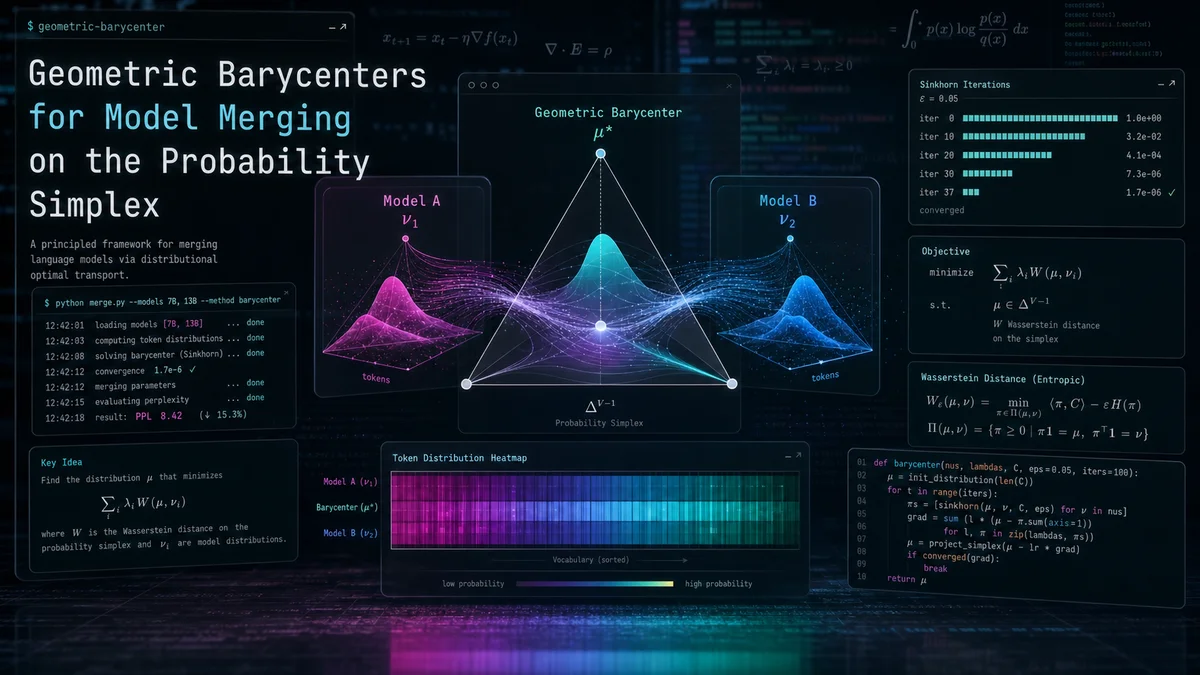
Reverse-KL barycenter as the target distribution: the paper targets a reverse-KL barycenter, a geometric combination of the teacher distribution p_t and student distribution p_s. Instead of copying teacher information verbatim, this target encourages the student to retain its existing distribution while selectively absorbing useful teacher signals.
-
Disagreement-based mixture control: at each token position, the method measures the difference between the teacher and student distributions—the paper explicitly uses token-wise discrepancy—and adjusts the teacher's influence according to its magnitude. Greater disagreement, where teacher and student predictions differ more, means adopting less of the teacher signal or otherwise adopting it more cautiously. Consult the paper for the exact scaling rule and formula.
Plain definition: a geometric, weighted-exponential combination of two probability distributions that reflects properties of both rather than following either distribution directly. Everyday example: it resembles choosing a compromise dish between two friends, one who prefers spicy food and one who prefers sweet food.
Theoretical Claims, Based on the Paper Summary
-
Leakage attenuation: the authors claim to show mathematically that DemoPSD effectively reduces privileged-information leakage. In other words, the student learns fewer answer-dependent shortcuts unavailable at test time.
-
Exploration preservation: the paper reports that DemoPSD suppresses entropy collapse caused by a dense teacher distribution and maintains greater uncertainty, and thus broader exploration, during training. The authors say that it maintains higher training entropy than GRPO and SDPO while achieving better generalization.
Plain definition: a problem where a model absorbs information available only during training, such as an answer demonstration, and appears to perform better by relying on clues unavailable in a real test. Everyday example: it resembles studying while looking at an answer sheet and then, without the sheet during the actual exam, knowing only how to solve problems in that same way.
Experimental Summary, Based on the Abstract
The paper reports that DemoPSD outperforms GRPO and SDPO on SciKnowEval across four scientific fields. It also describes robust generalization by the trained model on the OOD, or out-of-distribution, GPQA benchmark. The supplied HTML and evidence set, however, provide limited details about experimental hyperparameters, data splits, statistical-significance tests, and reproducibility. Reproduction or application therefore requires consulting the original PDF and any released supporting code or data.
Plain definition: the difference that arises when the teacher and student distributions make different predictions at the same token position. DemoPSD uses this disagreement as a signal to control teacher influence. Everyday example: it is like two people giving different accounts of a movie's ending.
Implications and Recommendations for Application
-
In practice, performance and safety are likely to be sensitive to token-wise discrepancy computation and the scaling rule for mixture weights. The mathematical claims and experimental results are promising, but the supplied HTML evidence is insufficient to verify every implementation detail.
-
In environments where OOD generalization matters, such as scientific question answering and domain transfer, DemoPSD's selective teacher-adoption design appears useful. Leakage attenuation is particularly valuable when privileged information exists only during training.
-
For validation, consult the original PDF's algorithm pseudocode and loss-function equations, as well as any released experimental scripts. The paper provides an intended DOI and an arXiv link through which further material may be found.
Limitations and Uncertainty
- This post summarizes and interprets the arXiv HTML and abstract for 2607.02502v1. The abstract and metadata state the core claims and results, but the evidence set may not contain detailed equation derivations, experimental settings, or further analyses such as failure cases and sensitivity experiments. Review the original PDF, appendices, and public code and data before technical reproduction or commercial use.
Conclusion
DemoPSD proposes a practical solution to overfitting, suppressed exploration, and privileged-information leakage caused by dense token supervision from a teacher. Its design targets a weighted geometric mean of the teacher and student distributions and adjusts the teacher signal token by token according to disagreement. The paper reports both theoretical grounding and empirical benefits, but implementation and reproduction require review of the source and supplementary material.
Sources
- DemoPSD: Disagreement-Modulated Policy Self-Distillation — license:
unknown, retrieved:2026-07-06. - Image: AI-generated cover image via OpenRouter — license:
ai-generated-original.