ReContext: Improving Long-Context Reasoning through Recursive Evidence Replay

ReContext, or RECONTEXT, is a training-free inference-time technique for helping a large language model use relevant information already present in its input more effectively. The source paper, for which only the arXiv abstract and metadata are currently available, is summarized as using the model's internal relevance signals to construct a query-conditioned evidence pool and replaying that evidence before final generation.
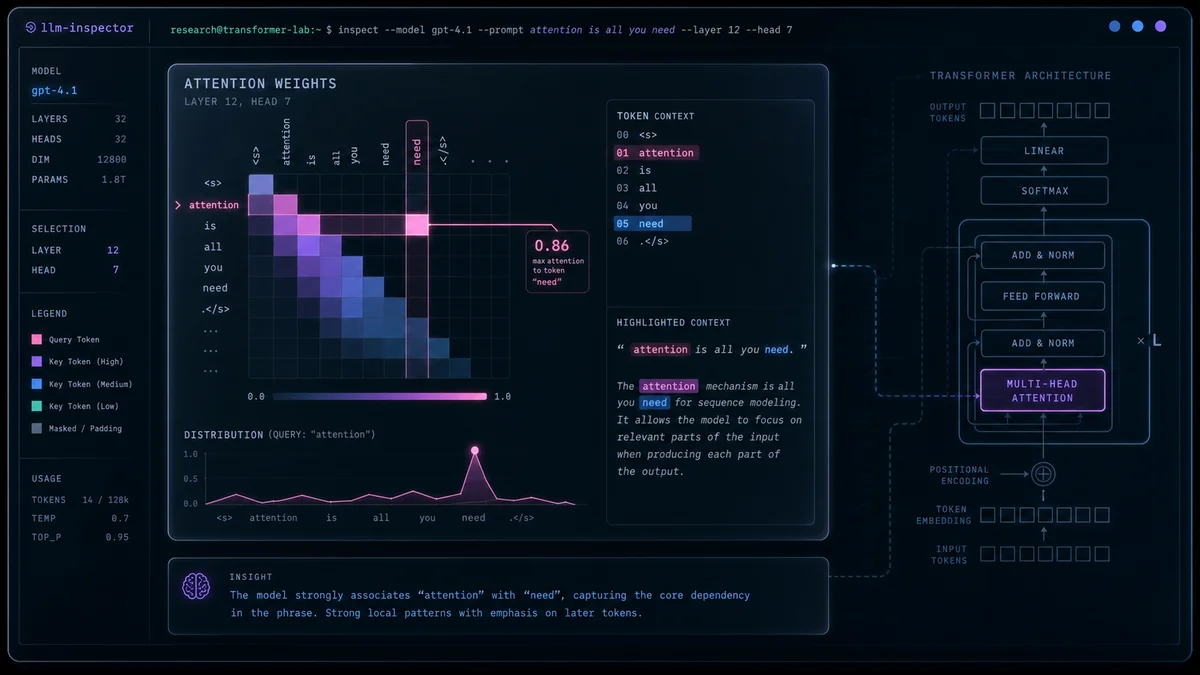
Overview
- Purpose: help a model find relevant evidence already present in a long context, such as a paper, long document, or log, and reflect it in the answer.
- Core idea: recursively select a query-conditioned evidence set through internal model signals such as attention-based relevance and replay the selected evidence before generating an answer. The process preserves the complete original context while separating evidence organization from answer generation.
- Claimed advantages: according to the paper, the method works without training or external memory and does not require context pruning. Experiments used contexts up to 128K tokens, and overall evidence utilization reportedly improved on Qwen3-4B, Qwen3-8B, and Llama3-8B.
Why It Matters
In real applications that handle long documents—report summarization, legal-document review, and reasoning over conversation logs—important evidence may be scattered across the document, but the model can use only part of it or miss relevant information. RECONTEXT is meaningful as a practical approach that more effectively revives information already present in the context and reflects it in the answer.
Core Method: An Estimated Summary
- Internal relevance signals: internal relevance during model generation, such as attention scores and similarity between tokens, is used as a signal to select context fragments related to the question sequentially or recursively.
- Query-conditioned evidence pool: the selected evidence is gathered for the question, or query, and supplied to the model again through replay for final answer generation. Importantly, the original complete context is retained rather than removed.
- Recursive selection: instead of ending with one pass, the method includes a recursive process that uses selected evidence to find additional relevant evidence. This is the core mechanism presented in the paper's title and abstract.
Theoretical Perspective: Associative Memory
The source interprets attention and replay through the perspective of associative memory. The main correspondences are:
- Context = memory store
- Question = retrieval cue
- Attention = cue-trace connection
- Replay = trace reactivation
This perspective explains why some information may be accessible yet not reflected in the actual response, and theoretically describes how replay can strengthen traces and improve response quality.
Plain definition: a process that repeatedly selects document fragments related to a question through internal model signals, then shows those fragments to the model again through replay so it can construct an answer. Example: it resembles first collecting key evidence paragraphs from a long report, then using that collection to find additional important paragraphs and produce a final summary.
Plain definition: a memory model in which a cue evokes a connected memory trace. In computing, needed information is found through associations between an input question and stored context. Example: just as the cue "umbrella" can evoke a memory of a rainy day, a question can bring a particular paragraph to mind.
Plain definition: the length of input tokens a model can "see" at once. A longer window lets the model process more documents at the same time. Example: if it is the number of book pages visible at once, seeing more pages together makes it easier to understand the context.
Experimental Claims Based on the Abstract
- Datasets: the paper reports experiments on eight long-context datasets.
- Context length: tests used contexts up to 128K tokens.
- Backbone models: RECONTEXT consistently improved evidence utilization on Qwen3-4B, Qwen3-8B, and Llama3-8B and reportedly achieved the best average rank.
- Code: the abstract states that code is public at https://github.com/Yanjun-Zhao/ReContext.
Limitations and Cautions
-
This post is a technical analysis based on the arXiv abstract, metadata, and links. The abstract does not reveal every detail from the PDF, including the complete algorithm, hyperparameters such as recursion depth and the precise definition of relevance signals, computational cost in latency and inference speed, or exact per-metric performance and statistical significance. Review the paper and code repository directly for implementation details and quantitative results.
-
Expected practical trade-offs that may not be stated directly in the abstract:
- Replay may require additional token processing and reinference, potentially increasing latency.
- Because the method depends on relevance signals, poor initial internal signals from the model may select the wrong evidence.
- Repeated replay over very long context may raise computation and memory requirements.
Applicability and Suggested Follow-Up Research
- Applications: long-document question answering, document summarization—especially evidence-grounded summaries—legal and medical document analysis, and problem solving based on log analysis.
- Follow-up research:
- Improve replay efficiency through selective compression and evidence prioritization, and study the latency-quality balance.
- Compare different internal signals, including attention, token-embedding similarity, and intermediate-layer representations.
- Evaluate evidence-selection reliability by combining the method with a human-in-the-loop review.
Conclusion
RECONTEXT appears to be a practical and theoretically grounded attempt to bridge the gap between "context access" and "context use." As a training-free inference technique, it has the potential to be applied to real systems relatively quickly. Assessing the actual balance of performance, cost, and latency still requires reviewing implementation details and quantitative results in the paper and public code.
Original paper and code:
- arXiv: https://arxiv.org/abs/2607.02509
- PDF and source: https://arxiv.org/pdf/2607.02509v1
- Code linked by the authors in the abstract: https://github.com/Yanjun-Zhao/ReContext
Sources
- ReContext: Recursive Evidence Replay as LLM Harness for Long-Context Reasoning — license:
CC BY 4.0, retrieved:2026-07-06. - Image: AI-generated cover image via OpenRouter — license:
ai-generated-original.