When LLM Personas Do and Do Not Support Visualization Design — A Cross-Model Study of Color Assignment and Chart Choice

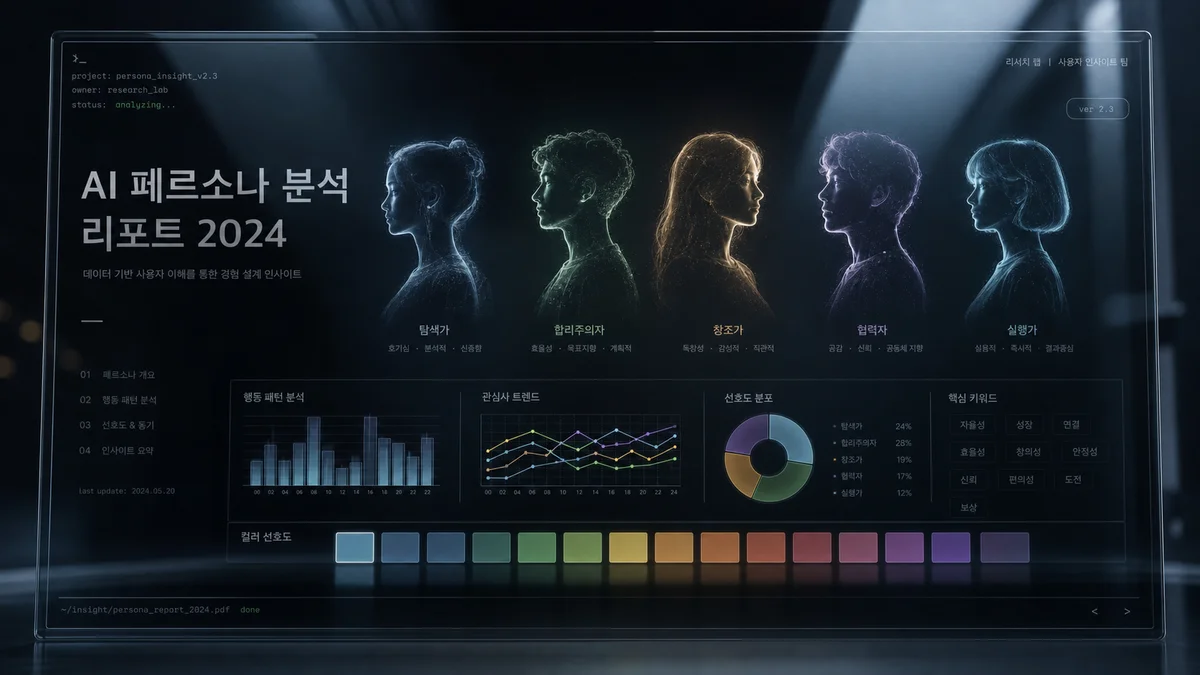
This post summarizes and offers a practical interpretation of Shahreen Salim and Klaus Mueller's 2026 arXiv paper "When Do LLM Personas Support Visualization Design? A Cross-Model Study of Color Assignment and Chart Choice" (arXiv:2607.02455v1). Using 43 Big Five personality profiles as personas, the study compared (1) color assignments to concepts and (2) chart-idiom preferences in task contexts across three LLM configurations: GPT-4o-mini, GPT-4.1-mini, and GPT-5-mini. The central observation is that the model configuration and concept type determine the presence and strength of persona signals.
Key findings, summarized
- Personality-color coupling strongly depends on the model configuration. According to the abstract, GPT-4o-mini showed no such signal for any of the six concepts, GPT-4.1-mini showed it consistently across all six, and GPT-5-mini showed a partial signal for two of the six.
- Concept type—abstract versus concrete—changes signal strength. For abstract concepts, personality factors affected color, measured as variance in hue around the color wheel, more strongly than model identity. For concrete concepts, the two effects were smaller and similar in magnitude.
- In chart-idiom preferences, trait-aligned cluster aggregation sometimes produced stable top-idiom rankings, but the no-persona baseline reproduced the same first choice in eight of nine model-context cells. In other words, task context tended to determine the top choice more strongly.
- Concluding recommendation: LLM personas should be used as exploratory probes in visualization design, not as evidence capable of replacing human participants. Multi-model testing, separation by concept type, and a no-persona baseline are essential.
Simple definition: An LLM persona is a setting that assigns a "personality profile" or "user type" to a large language model and prompts it to respond from that perspective. Everyday example: Think of it as an expanded version of a product planner collecting feedback separately from "conservative users" and "innovation-preferring users."
Simple definition: A statistical association between a personality trait, such as extraversion, and a particular color choice, such as a bright or warm color. Everyday example: It resembles a marketing decision to favor orange and yellow to convey a "young and energetic" image.
Simple definition: The type of chart—such as a bar, line, or pie chart—that a person or model naturally selects for a particular data context. Everyday example: Most people thinking of a line chart when asked to show change over time is one chart idiom.
Caveats about method, evidence, and scope
- This analysis is based on the paper's abstract and metadata, including its summary, model names, and number of personas. The original is listed as five pages with three figures, but this summary did not review every detail of the experimental setup, such as statistical tests, sampling methods, and exact prompt text. Consult the original PDF at
/pdf/2607.02455v1for detailed figures and statistical significance.
Retained source image and its meaning

The icon above indicates that the paper uses the Creative Commons Attribution 4.0 (CC BY 4.0) license. It is important to practitioners reusing code or sharing research summaries because it permits reuse and redistribution of the paper's text and results with proper attribution.
Brief practical recommendations
- During prototyping, use LLM personas as a rapid idea-generation tool, but pair them with human-participant experiments before drawing conclusions.
- Cross-validate across multiple models or configurations rather than depending on a single model's biases or artifacts. This study shows that the same persona can produce different results across models.
- Separate abstract and concrete concepts when analyzing and interpreting results. Personality effects were comparatively clearer for abstract concepts.
- Always include a no-persona baseline to determine whether the persona actually contributes to decision rankings.
Conclusion
The paper shows that LLM-based personas can be useful for exploring visualization designs while warning that results are sensitive to model configuration, concept type, and task context. Readers should consult the original PDF for deeper statistical details, prompt design, and experimental reproduction.
Sources
- When Do LLM Personas Support Visualization Design? A Cross-Model Study of Color Assignment and Chart Choice — license:
CC BY 4.0, retrieved:2026-07-06. - Image: AI-generated cover image via OpenRouter — license:
ai-generated-original.