Firecrawl: A Web-Scale Data Collection Platform from an Infrastructure Perspective

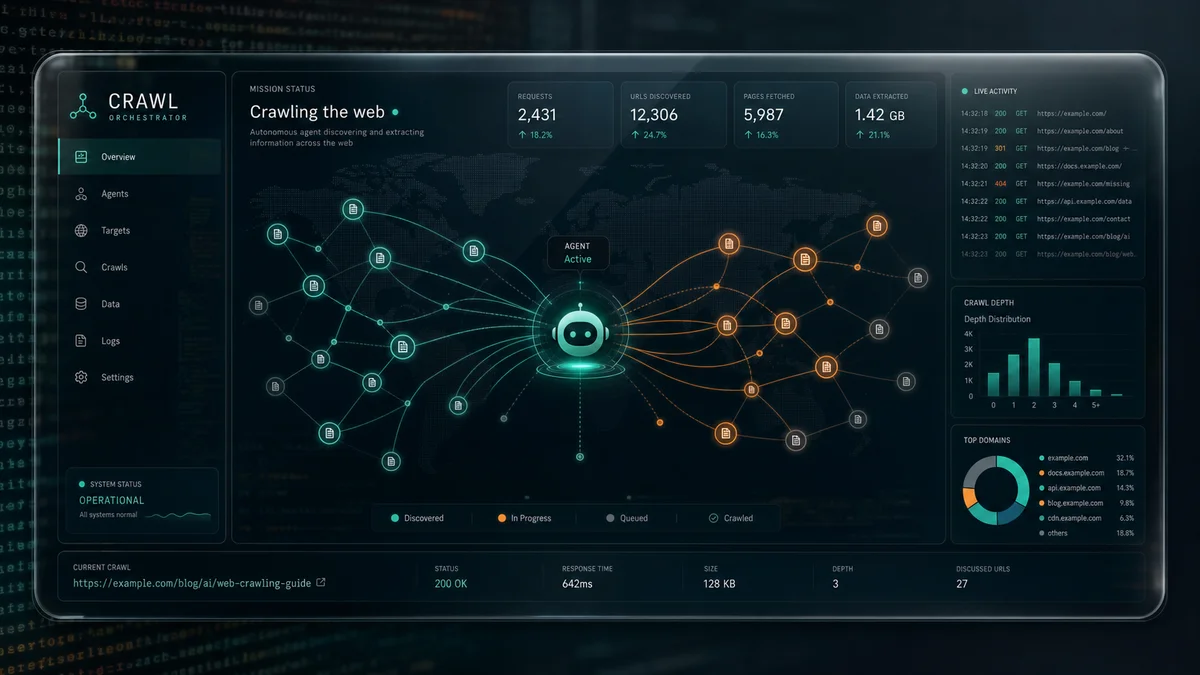
The repository documentation introduces Firecrawl as "The API to search, scrape, and interact with the web at scale." Alongside its public AGPL-3.0 codebase, it provides a hosted service that bundles typical web-data collection features such as Search, Scrape, Interact, Agent, and Crawl into APIs and SDKs. Prominent repository claims such as "covers 96% of the web" and "P95 latency of 3.4s" present notable targets for performance and reach, but the evidence package does not fully include benchmark details such as measurement conditions and the target-site set. The sections below therefore combine a public-documentation summary with an infrastructure-oriented interpretation.
Core Features from the Documentation
- Search: finds results across the web and returns the full content of result pages.
- Scrape: converts any URL into LLM-friendly output such as Markdown, structured JSON, and screenshots.
- Interact: provides an action layer for clicks, scrolling, and input within a scraped session.
- Agent: a high-level workflow that automatically searches, navigates, and extracts from a stated objective, such as collecting particular information, without requiring a URL.
- Crawl / Map / Batch Scrape: supports whole-site crawling, site-map generation, and large asynchronous scraping jobs.
- SDKs: SDKs for Python, Node.js, Rust, Java, Elixir, and other languages, plus a CLI, improve developer experience with automatic polling and intuitive APIs.
These points are grounded in the repository README and examples in its Python, Node.js, cURL, and CLI Quick Start sections.
Notable Infrastructure and Operational Considerations
- Breadth versus practical constraints
- The documentation claims that Firecrawl "covers 96% of the web, including JS-heavy pages." This suggests operation of browser-based rendering or a headless-browser pool capable of JavaScript execution and dynamic loading. The evidence package, however, does not include operational parameters such as pod count, browser-instance management policy, or JavaScript timeout and retry strategy, so the exact implementation cannot be confirmed.
- Proxies, IP rotation, and evasion of blocks
- The documentation says, "We handle the hard stuff: Rotating proxies, orchestration, rate limits, JS-blocked content." Reliable collection at scale requires diverse proxy pools, geographic distribution, classification of failure types such as 404, 403, CAPTCHA, and browser delay, and adaptive retry logic. When self-hosting, proxy management, cost, and compliance are important design points.
- Latency and throughput
- A documented benchmark such as P95 latency of 3.4 seconds matters for real-time agent integration, but may vary substantially with page type, network, and JavaScript load. Concurrency, queueing, and backpressure design are central to large batch crawls.
- Interactive workflows and state management
- Interact maintains state through a scrape ID and applies events such as clicks and input sequentially. This implies a session store containing screenshots and DOM snapshots, long-session timeouts, and a session-recovery strategy.
- Agents and structured output
- Agent automates goal-oriented navigation for tasks such as "Find the founders of Firecrawl." Because it composes search, navigation, and summarization rather than merely parsing HTML, the documentation reveals internal integration with LLMs, source tracking through a
sourcesarray, and schema-based structuring such as its Pydantic example.
Design and Operations Checklist
- Proxy design: provider-managed, self-managed, or hybrid proxies; geographic distribution; rotation policy
- Browser pool: headless-browser instance management, memory and CPU cost, and reuse policy
- Error classification and retries: distinct paths for CAPTCHA, JavaScript errors, and network failures
- Sessions and state: session database and retention policy for Interact and Agent
- Cost and billing: cost modeling for batch crawls, real-time requests, and Agent model calls
- Security and compliance: logging and whether it includes sensitive data, adherence to robots.txt and terms of service, and legal-risk review
Quick Start, Summarized from the Documentation
Condensed Python example:
from firecrawl import Firecrawl
app = Firecrawl(api_key="fc-YOUR_API_KEY")
# Search
search_result = app.search("firecrawl", limit=5)
# Scrape
result = app.scrape('https://firecrawl.dev')
# Interact: apply an action to the session after scraping
app.interact(result.metadata.scrape_id, prompt="Click the first result")
The documentation also includes Node.js, cURL, and CLI examples; see its Quick Start section.
Term Explainers
Plain definition: extracting web-page content into a machine-processable format such as Markdown or JSON. Example: extracting the body and image captions from an online article and saving them in a Markdown file.
Plain definition: a high-level workflow that receives a user objective and automatically searches, navigates, and extracts, internally composing search, scraping, page interaction, and summarization. Example: when asked to "find and compare the pricing tables for a particular service," the agent locates the pages and organizes the prices.
Plain definition: output whose text has been cleaned and structured for input to a large language model, removing unnecessary elements and reducing tokens. Example: the result of removing advertisements and navigation from an online article and retaining only the main content in Markdown.
Plain definition: automatically visiting every linked page from one domain or starting URL and collecting its content. Example: automatically visiting every blog post on a company's domain to build an archive.
Preserved Image from the Documentation

The repository documentation uses this visual to explain "Open Source vs Cloud." Firecrawl states that it operates both AGPL-3.0 open-source code and a separate hosted service at firecrawl.dev. The image helps distinguish self-hosting from additional cloud functionality. Review configuration and operating cost and any feature differences before self-hosting.
Limitations and Uncertainties
- The documentation states feature lists and some benchmarks such as coverage and P95 latency, but the evidence package lacks reproduction details including environment, target pages, and concurrency. Actual performance depends heavily on target-site characteristics, network conditions, and settings such as browser timeout and proxy pool.
- Security and legal concerns, including robots.txt compliance and possible violations of terms of service, require review for each use case. The documentation explains features but does not provide legal advice.
Conclusion from an Infrastructure Perspective
Firecrawl is a platform that integrates web search, scraping, and interaction with an emphasis on agent automation and LLM-friendly output. Operationally, proxy and browser pools, session management, error classification, and retry policy are core design elements, and the trade-offs between self-hosting and the hosted service must be understood clearly. The reproducibility of performance figures in the public documentation also requires validation in the actual operating environment.
Reference: original repository and documentation — https://github.com/firecrawl/firecrawl, including the README, Quick Start, and SDK sections.
Sources
- firecrawl/firecrawl (GitHub repository) — license:
AGPL-3.0, retrieved:2026-07-06. - Image: AI-generated cover image via OpenRouter — license:
ai-generated-original.