Statey: A Shared Database Inside AI Chat, Based on MCP

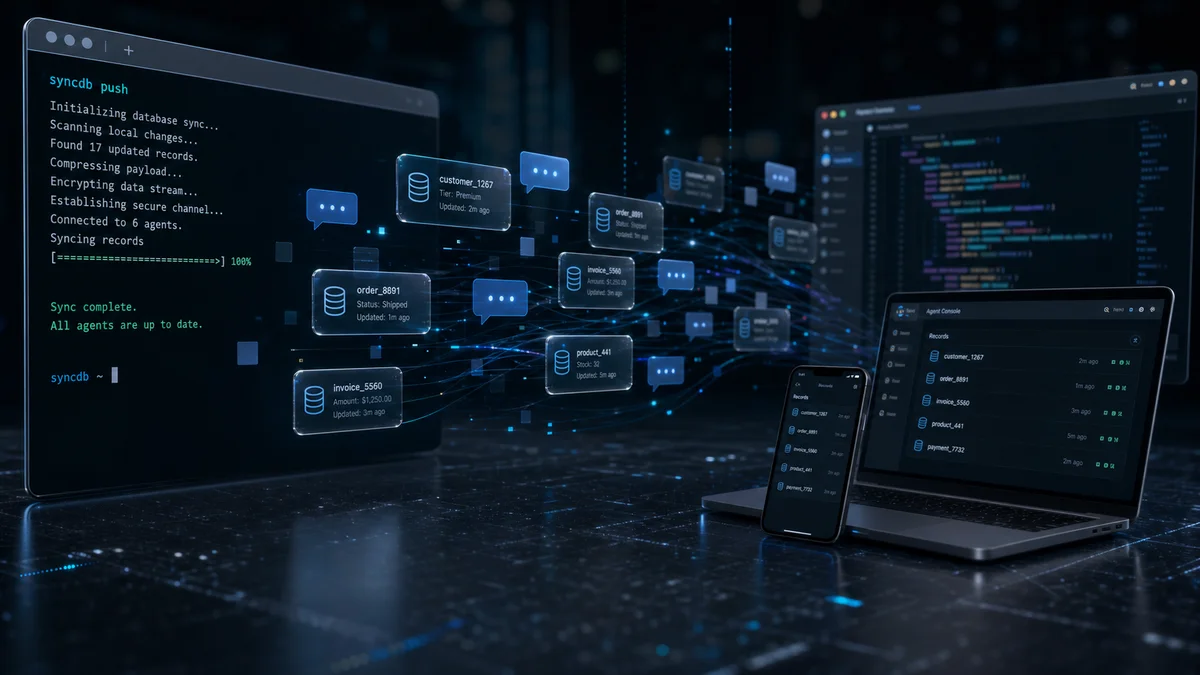
Over the past several years, developers, product teams, and conversational-AI users have moved the center of their work into chat. Statey follows this trend with a database design that allows records such as tickets, customers, and documents to be stored, queried, and changed inside MCP (Multi-Client Protocol) chat sessions rather than through a separate UI. This article organizes Statey's architectural ideas and the technical questions that should be reviewed from practical integration and operational perspectives.
In summary, Statey's main claims and features are:
- Chat is the application: users can read and write the same data from multiple MCP-compatible clients, including Claude, Cursor, and ChatGPT.
- Validated record model: field validation and change-history logging maintain state consistency.
- Multiclient synchronization: several agents, whether people or bots, can safely share the same records.
- Trigger and reaction model: data changes such as creating a record can wake an agent and initiate automatic response and processing flows.
- Pricing model: fees are based on stored-record capacity, while read and write activity is included without a separate charge.
These points were collected directly from the marketing and product descriptions on the official site. Implementation details such as internal API specifications, authentication and authorization models, distributed consensus for resolving concurrent edits, and large-scale performance curves are mentioned only to a limited extent in the public materials and require further confirmation.
Analysis from Design and Operational Perspectives
1) Advantages of a Chat-Centered Database
- Lower cognitive cost: users can create, query, and modify records without leaving their existing chat interface, reducing the cost of switching workflows.
- Benefits of structure and validation: managing data as records rather than free text standardizes state classifications such as
status. This improves the accuracy of search, aggregation, and automation triggers. - Multiclient synchronization: collaboration between agents becomes possible when multiple LLMs and clients share one data model.
2) Potential Technical Challenges
- Concurrency and conflict resolution: little information is provided about how conflicts are resolved when several clients or agents modify the same record simultaneously, whether through locks, OT, CRDTs, or another method. This is an important operational concern.
- Authorization and validation boundaries: the documentation does not sufficiently expose implementation details for fine-grained ACL policies such as "who can change which field" or for the audit model.
- Trust and security: authentication and delegated authorization when third-party agents, such as external LLM plugins, access records require security analysis.
- Scalability and cost forecasting: storage-based pricing is simple and may be preferred, but latency and throughput in pipelines with frequent high-volume reads and writes must be measured through testing.
3) Suggested Operational Patterns
- Introduce an explicit authorization model during initial design: separate permissions for human actions from those of automated assistants to reduce incidents.
- Govern trigger use: automation triggers are convenient, but misconfigured rules can create loops through infinite reprocessing. Add safeguards such as maximum retries and idempotency checks.
- Audit-log and rollback strategy: establish operational procedures that use change history to restore corrupted state.
Term Explainers
Plain definition: a protocol or integration layer that allows multiple AI clients such as Claude, Cursor, and ChatGPT to communicate with the same service. Everyday example: just as an email client using IMAP can show the same mailbox across devices, MCP lets several AI interfaces access the same data.
Plain definition: one database item, such as a ticket or customer, represented as a structured object with fields including status, owner, and history. Everyday example: one shipment at a parcel company is a record, with a status such as in transit, a recipient, and a history.
Plain definition: an action or workflow that runs automatically when a particular data change occurs, such as creating a ticket. Everyday example: when a new order arrives, a notification and task automatically begin checking inventory.
Integration and Evaluation Checklist
- Authentication and authorization: check support for SSO, token delegation, and role-based access control (RBAC).
- Consistency model: determine whether consistency is strong or eventual, and identify the conflict-resolution strategy.
- Auditing and compliance: verify change-history retention periods, deletion policies, and data-retention rules.
- Automation safety: verify mechanisms for detecting and stopping trigger and agent loops.
- Cost-performance profile: clarify storage-billing boundaries, including whether metadata counts, and measure latency in I/O-heavy workloads.
Conclusion and Recommendation
Statey naturally embraces the current workflow of "using chat as the application." It is an interesting product because it directly connects structured records and validation and audit capabilities to conversational context. Applying it to enterprise or sensitive-information workloads, however, requires validating implementation details for authentication and authorization, conflict resolution, large-scale performance characteristics, and trigger safety through documentation and testing.
Information available in the official documentation is limited to the product's core concepts and user experience, including synchronization between MCP clients, storage-based pricing, and change history. Public material on the internal API, security model, and actual scaling behavior is limited, so a proof of concept and security and performance evaluation are recommended before adoption.
Note: this article summarizes and analyzes the supplied public website documentation at https://www.statey.ai. Further implementation and operational-policy details should be confirmed through official documentation and support channels.
Sources
- Your task tracker, CRM, and notes. Inside the AI chat you already live in. — license:
unknown, retrieved:2026-07-06. - Image: AI-generated cover image via OpenRouter — license:
ai-generated-original.