p4r4d0xb0x
Rustacean, AI, OSS Enthusiast
View all authors

A Paper Roadmap for Understanding Surrogate Gradients

· 11 min read
p4r4d0xb0x
Rustacean, AI, OSS Enthusiast

Surrogate gradients are a detour connecting spiking neural networks, or SNNs, with the training tools of modern deep learning. The forward pass uses real spikes, while the backward pass uses a differentiable fake gradient. That sounds simple in one sentence, but properly understanding the idea requires three pieces of background.

First, why are spiking neurons discontinuous dynamical systems? Second, why does backpropagation require differentiability? Third, how were SNNs trained before surrogate gradients, and what prevented those methods from progressing?


HiPPO: Recurrent Memory with Optimal Polynomial Projections — A Paper Commentary

· 12 min read
p4r4d0xb0x
Rustacean, AI, OSS Enthusiast

Based on the paper "HiPPO: Recurrent Memory with Optimal Polynomial Projections," this article explains the motivation, mathematical intuition, central method—continuous-time ODEs and discretization—major results, and limitations of the authors' HiPPO framework step by step. Beyond a simple summary, the goal is to let non-specialists follow why this perspective is needed, what intuition solves the problem, and how the equations and algorithm connect.

Textbooks Are All You Need — Improving Small Code LLMs with High-Quality Textbook Data

· 7 min read
p4r4d0xb0x
Rustacean, AI, OSS Enthusiast

Microsoft Research's Textbooks Are All You Need focuses on phi-1, a small 1.3B-parameter LLM specialized for code, and experimentally shows that curated textbook-quality data and a small synthetic exercise dataset can achieve strong code-generation performance without scaling models and data to enormous sizes. The central reported results, based on the paper's abstract and main-text summary, are that phi-1 achieves 50.6% pass@1 on HumanEval and 55.5% on MBPP while using approximately 6B tokens of filtered web data, fewer than 1B tokens of synthetic textbook data, and approximately 180M tokens for finetuning.

AgentsCAD: Automated Design for Manufacturing of FDM Parts — Multi-Agent LLM Reasoning and Geometric Feature Recognition

· 6 min read
p4r4d0xb0x
Rustacean, AI, OSS Enthusiast

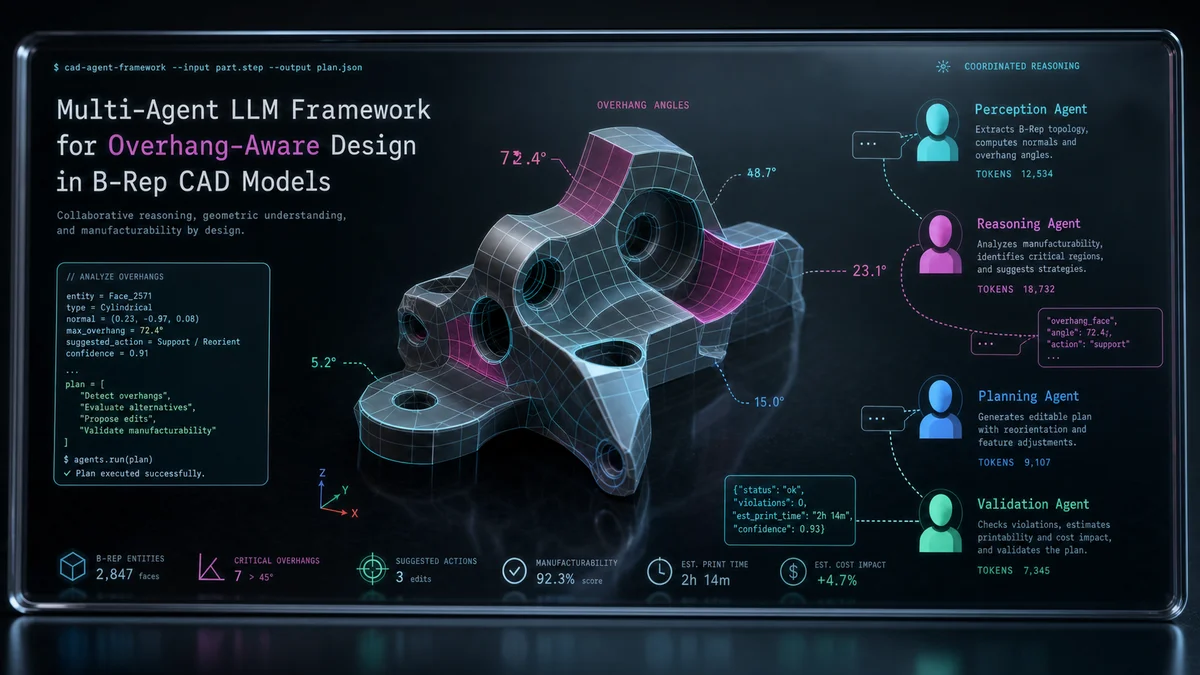
AgentsCAD proposes a pipeline that combines geometric feature recognition with multi-agent LLM reasoning agents to automatically diagnose design-for-manufacturing (DFAM) requirements for Fused Deposition Modeling (FDM) parts and generate modification recommendations. Based on the arXiv abstract and public metadata, this post provides a technical summary of the system architecture, core techniques, and the birdhouse example described in the paper, while clearly marking details that cannot be verified from the available evidence.

Best AI Agent Red Teaming Tools in 2026: Features, Limitations, and Adoption Considerations

· 7 min read
p4r4d0xb0x
Rustacean, AI, OSS Enthusiast

Based on the provided article published on June 4, 2026, this post summarizes and analyzes nine major AI agent red-teaming tools and the key questions practitioners should consider. The material is organized around each product's strengths and limitations and four evaluation axes important to agentic AI testing: integrating security and quality, agent-native support, the vulnerability-response flow, and product versus process. The source describes each tool and its limitations, but some implementation details such as internal architecture, exact detection rates, and cost data are not included in the public evidence; those gaps are stated below.

AISBF — Operating an OpenAI-Compatible Router and Local CoderAI Workers

· 5 min read
p4r4d0xb0x
Rustacean, AI, OSS Enthusiast

AISBF is a lightweight control plane centered on an "OpenAI-compatible gateway" that combines multi-provider routing, local GPU workers called CoderAI, rotation and failover paths, and privacy and policy controls. This post provides a technical summary of features and operational considerations visible in the public demo and documentation at aisbf.cloud. Because the source does not clearly provide specific design or performance figures, the analysis marks uncertain areas.

AutoGPT Platform Analysis: Agent Platform Architecture and a Practical Self-Hosting Guide

· 5 min read
p4r4d0xb0x
Rustacean, AI, OSS Enthusiast

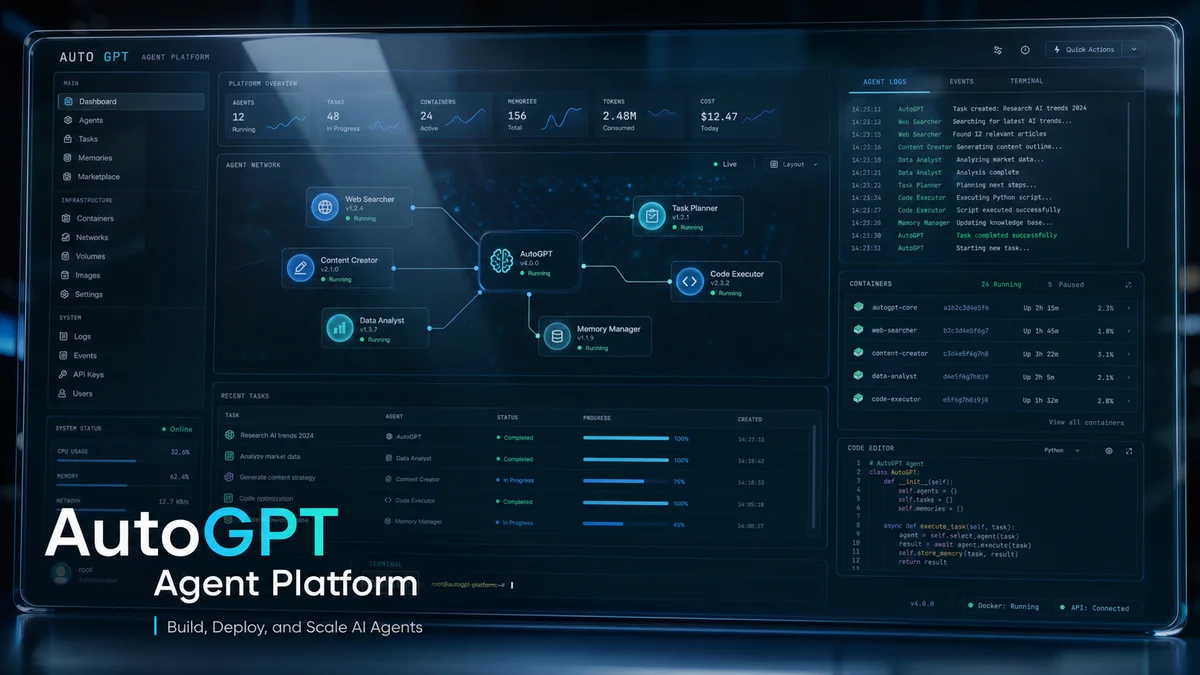
Based on the AutoGPT repository README and related documentation excerpts, this post provides a technical overview of the AutoGPT platform's main autogpt_platform components, self-hosting procedure, developer tools—Forge, agbenchmark, the CLI, and the frontend—and licensing considerations. The source is distributed across the repository README and partial documentation, so some details below are not fully contained in the provided evidence. Consult the linked official documentation as well.

Claw Patrol: Design and Operational Perspectives on a Firewall for Agents

· 5 min read
p4r4d0xb0x
Rustacean, AI, OSS Enthusiast

cover

Claw Patrol is a gateway that intercepts network traffic generated by agents—processes or automated agents—and inspects and blocks it in real time so that unnecessary or dangerous requests do not reach production systems. Based on the public README and repository information, this post provides a technical overview of the architecture, rule languages, deployment options, and operational considerations. It reflects only facts from the source where possible and marks uncertainty where implementation details outside the repository, such as every internal edge case, are absent from the evidence.