Overview of the LangChain Agent Engineering Stack

As summarized by the phrase "The agent engineering platform" in its README, LangChain is a framework that supports rapid prototyping and operation by modularly connecting the components used to build agents and LLM-based applications, including chains, retrievers, vector stores, and model interfaces. The README emphasizes model interoperability and integration with external systems through standard interfaces for models, embeddings, vector stores, and retrievers.
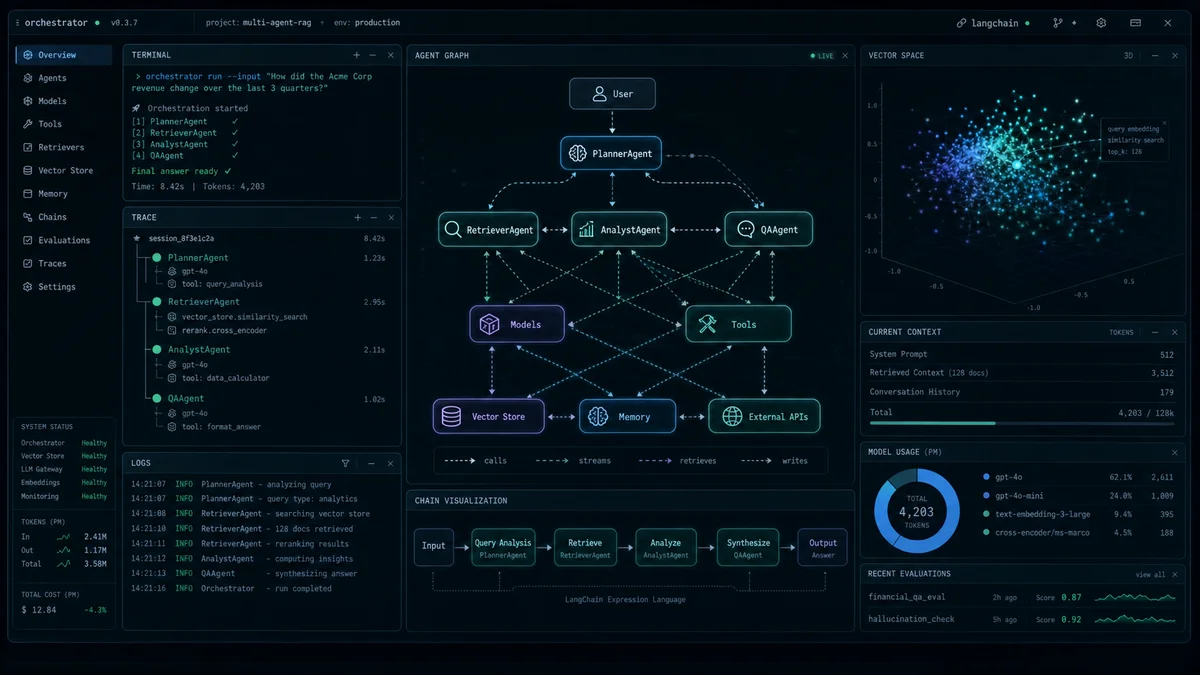
Key Takeaways
- Purpose: make it easy to construct practical workflows by connecting models, data sources, search components (retrievers), and tools in LLM applications
- Strengths based on the README: model interoperability, extensive integrations, layered abstractions for rapid prototyping, and operational and debugging support through products such as LangSmith
- Ecosystem: complementary projects such as Deep Agents, LangGraph, and LangSmith are presented together to form the broader platform
Why Is This Useful in Practice?
- Abstracting multiple models and vector stores reduces the weight of early design decisions, based on the README's descriptions of "Model interoperability" and "Real-time data augmentation"
- Replaceable and extensible components lower the cost of moving from experimentation to production
Quick-Start Example from the README
A simplified version of the example in the README:
uv add langchain

from langchain.chat_models import init_chat_model

model = init_chat_model("openai:gpt-5.5")
result = model.invoke("Hello, world!")
This example shows that LangChain provides an abstraction layer for model initialization and invocation. A real environment also requires provider configuration, authentication, response-format handling, timeout policies, and other settings.
Main Components and Practical Considerations
1) Agents
LangChain is designed to combine external tool calls, planning, subagents, and other subordinate workflows through agents. The README uses the phrase "agents and LLM-powered applications."
Plain definition: a component that combines a model with tools such as search and API calls, then plans and executes the sequence needed to complete a task. Everyday example: it resembles a shopping proxy service that receives a customer request and automatically handles product search, comparison, and payment.
Practical consideration: agents are powerful, but external tool calls, state management, and security issues such as sensitive-data exposure require permission controls, planning logs, and reproducibility tools.
2) Chains — Composable Processing Pipelines
Chains are abstractions that connect units such as model calls, preprocessing, postprocessing, and retriever calls in sequence. High-level chains suit rapid prototyping, while low-level components suit fine-grained adjustment.
Plain definition: a module that completes an overall task by connecting several processing stages in order. Everyday example: it resembles a coffee order progressing through order receipt, payment, extraction, and serving.
Practical tip: design reusable chains with abstract input and output specifications, and consider an orchestration tool such as LangGraph for complex flows.
3) Retrievers and Vector Stores
As the README's emphasis on "Real-time data augmentation" suggests, a central workflow connects external documents and databases to provide context to an LLM. A vector store stores embeddings and provides similarity search.
Plain definition: a search component that uses embeddings to find relevant documents and supplies them to an LLM as context. Everyday example: it resembles a librarian selecting the books most relevant to the subject you want to find.
Plain definition: a repository that stores document embeddings, or numerical vectors, and supports similarity-based search. Everyday example: it resembles a music-recommendation database that stores melodies as numerical features and finds similar songs.
Practical caution: the choice of vector store, such as FAISS, Milvus, or Weaviate, substantially affects performance, operability, and cost. The index update strategy—real time or batch—is another design decision.
4) Model Abstraction and Interoperability
The README explicitly states "Model interoperability," explaining that LangChain abstracts multiple model providers, including OpenAI and Anthropic, so they can be swapped. This allows rapid replacement during research and product experimentation.
Plain definition: a neural-network model trained on large-scale text data that can understand and generate natural language. Everyday example: it behaves somewhat like an expert who has read many books and documents and then answers questions.
From an operational perspective, switching models involves trade-offs in cost, response quality, latency, and safety through output control. LangChain's abstraction reduces the switching cost, but each model's API, price, and limitations still require separate review.
Ecosystem and Related Products from the README
- Deep Agents: a package that provides higher-level agent patterns such as planning, subagents, and filesystem access
- LangGraph: a low-level framework for agent orchestration
- LangSmith: a platform for agent evaluation, monitoring, and debugging
The README classifies these components as the "LangChain ecosystem." Rather than trying to satisfy every operational requirement with one project, this approach addresses problems through products separated by role.
Operational Metadata Visible in the README
The badge above indicates the project's MIT license and is useful for quickly assessing open-source terms and considerations for commercial use.
The downloads badge suggests PyPI traffic, but adoption and activity are more accurately interpreted alongside stars, forks, and community discussion.
The version badge helps assess the package's release cadence and compatibility management. The README summarizes the project's purpose, structure, and links, but release notes are needed to evaluate compatibility and migration strategy.
Note: the images above are badges provided by the README and are intended to convey public project metadata—license, downloads, and version—at a glance.
Brief Production-Adoption Checklist
- Requirements: real-time response versus batch processing, sensitive-data handling, and SLA
- Architecture: separation of agents, chains, and retrievers, plus strategies for preserving state and logs
- Security: tool-call permissions, secret-exposure prevention, and output filtering
- Testing and validation: establish an evaluation and debugging process with tools such as LangSmith
- Operations: vector-store infrastructure—managed versus self-hosted—cost monitoring, and experiments for switching models
Limitations and Uncertainty
- The README summarizes the framework's purpose and ecosystem, but internal implementation details such as the performance characteristics of specific components and internal API changes require direct review of the code and release notes.
- A real production migration requires reviewing Contributing, SECURITY, release notes, and the API reference in addition to the README.
References and Further Reading
- Official documentation: https://docs.langchain.com/oss/python/langchain/overview
- Ecosystem overview linked from the README: Deep Agents, LangGraph, and LangSmith
Sources
- langchain-ai/langchain (GitHub README) — license:
MIT, retrieved:2026-07-06. - Image: AI-generated cover image via OpenRouter — license:
ai-generated-original.