The NautilusTrader Engine: Analyzing Rust-Native Research-to-Execution Parity

According to its README and repository metadata as of July 6, 2026, NautilusTrader describes itself as an "open-source, production-grade, Rust-native engine for multi-asset, multi-venue trading systems." Drawing on the public repository text, this article analyzes the architectural intent and the implications of its design choices for research-to-production parity workflows.
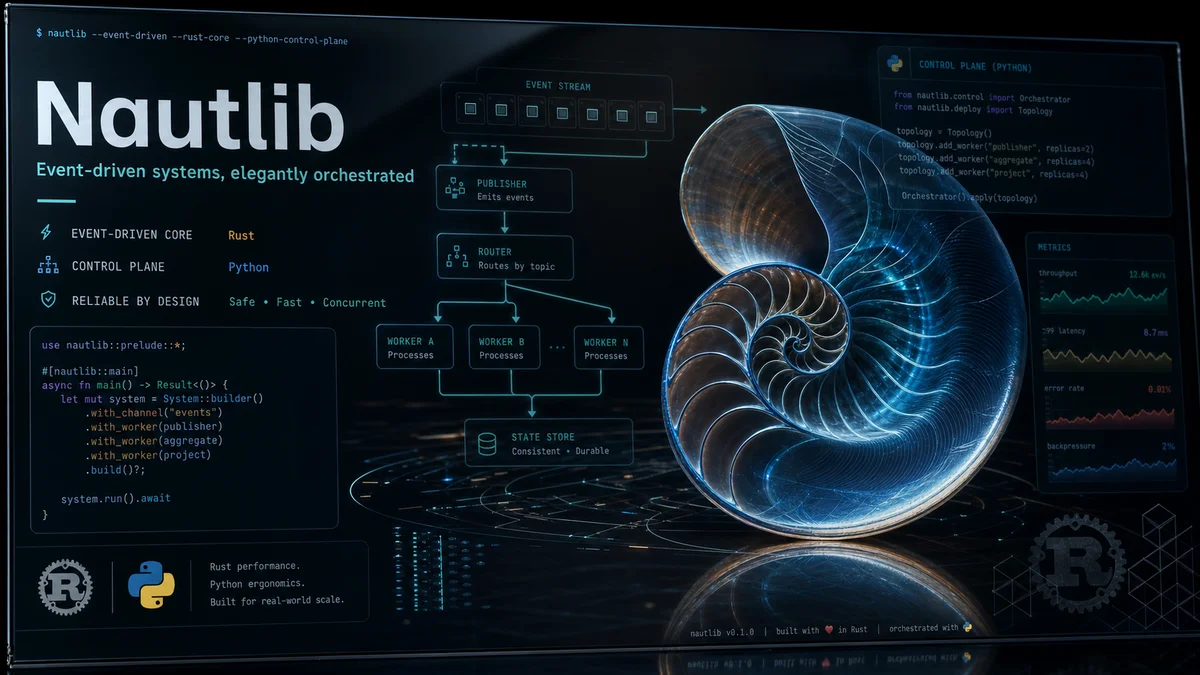
Summary: The repository description and README make three central claims: (1) a high-performance Rust core, (2) Python as a control plane for strategy, configuration, and orchestration, and (3) identical execution semantics for research, deterministic simulation, and live execution within a single event-driven architecture. The sections below break down each claim and identify its technical implications and remaining uncertainties.
Core design elements and technical implications
- Rust-native core: performance and safety
- According to the repository documentation, the core is implemented in Rust and aims to be "Fast" and "Reliable" through the mimalloc allocator and Tokio-based asynchronous networking. Rust's type and thread safety and an optional Redis-backed state-persistence mechanism are also mentioned.
Simple definition: The part that implements a program's core execution logic in compiled Rust code, with high performance and memory safety as goals. Everyday example: Like a database engine written in C, the performance-critical core is built in a compiled language.
Implication: A Rust core is a suitable choice for a trading engine with demanding latency and concurrency requirements. The supplied evidence—the README and repository summary—does not, however, include specific benchmark figures, latency distributions, or data about GC effects, though Rust of course has no garbage collector. Performance claims such as an "engine fast enough to train AI agents" therefore indicate design potential, but require separate benchmarks for quantitative validation.
- Python control plane: separating research and orchestration
- According to the documentation, Python serves as the control plane for strategy logic, configuration, and orchestration. It states that PyO3 provides bindings to the Rust v2 runtime while the legacy Cython v1 runtime is retained.
Simple definition: The part of a system that sets "policy" and issues instructions, handling high-level logic such as configuration, strategy, and orchestration. Everyday example: In a smartphone music app, the play button, or user control, is the control plane, while the actual audio engine is the data plane.
Implication: Using Python as the control plane improves strategy-development productivity and simplifies integration with the data-science ecosystem, including pandas, NumPy, and RL toolkits. The phrase "No Rust toolchain required at install time" shows that installation convenience has been considered, but the repository evidence contains no detailed profile of runtime integration costs, especially at the Python–Rust boundary on high-frequency paths.
- Single event-driven architecture and deterministic simulation
- The README emphasizes a "single event-driven architecture" and "deterministic simulation." It claims that research and live environments share the same execution semantics, allowing deployment without code changes during the research-to-production transition.
Simple definition: A simulation that always produces the same result when given the same initial state and event sequence. Everyday example: It is like expecting bread made from the same ingredients and recipe under the same starting conditions to have the same shape and taste every time.
Implication: Determinism offers major advantages for reproducibility, debugging, and backtest trustworthiness. The README and repository summary do not provide low-level implementation details about how determinism is guaranteed, such as timestamp processing, random-seed management, or network-latency reproduction. Additional documentation or test cases are therefore required to verify whether research and live parameters behave identically in practice.
- Adapters and multi-venue strategies
- The material says that adapter-based integrations can connect almost any venue offering a REST API or WebSocket feed. The repository's integration table links to guides for a range of exchanges and vendors.
Simple definition: A translation layer that connects an external system, such as an exchange API, to an engine's internal interface. Everyday example: Think of an adapter that converts between different plug standards, such as USB-C and USB-A.
Implication: The adapter pattern normalizes different markets—including cryptocurrency, traditional assets, and betting—into a single domain model, improving strategy reuse. Public evidence does not reveal in detail how semantic gaps between venues are standardized, including differences in orders, fills, rate limits, and order-book models such as partial fills and post-only semantics.
Documentary evidence and remaining uncertainties
- Evidence: This article primarily relies on the repository README, file listing, integration table, and project-overview statements. Phrases in the README such as "Rust-native engine," "Python serving as the control plane," and "deterministic time model" are the main sources.
- Uncertainty: The supplied evidence package does not include concrete performance benchmarks such as latency distributions and throughput, determinism-verification tests, boundary-cost profiles, or low-level documentation of per-adapter semantic adjustments. The design philosophy and goals are therefore clear, but empirical production performance requires additional material such as benchmark reports and operational case studies.
Why these images appear important
 This logo acts as the project's key identifier in its README. Placed in the documentation header, it visually supports the project's claim to be "production-grade" and provides an initial impression of the brand and scope when reviewing the repository structure and feature list.
 This artwork symbolically presents the project's design and philosophy of modularity and extensibility. The README's "nautilus" explanation—a growing modular structure and logarithmic-spiral analogy—is consistent with its architectural emphasis on modularity.
Simple definition: A library that simplifies building bindings between Rust and Python, allowing Python to call functionality written in Rust directly. Everyday example: Think of it as a linkage that lets a cockpit, the convenient Python interface, easily control a car engine, the powerful Rust code.
Conclusion and recommended validation process
-
Conclusion: The repository evidence clearly shows that NautilusTrader adopts a Rust-centric, high-performance engine design targeting research-to-live parity. Its Python control plane, deterministic simulation, and adapter-based integrations provide practical advantages in strategy reproducibility, rapid research feedback, and support for diverse venues.
-
Recommended validation process—a practical checklist:
- Deterministic simulation reproducibility: Repeat simulations with the same seed and input data and confirm that results match.
- Boundary-cost profiling: Measure call overhead at the Python–Rust boundary and latency growth under high event volume.
- Adapter-semantic validation: Document each integration target's order and fill semantics—such as partial fills and post-only behavior for Binance or Betfair—as test scenarios.
- Production benchmarks: Obtain benchmark reports for P99 latency, throughput, and memory usage.
Note: This analysis summarizes and interprets the public README and repository index text collected on July 6, 2026. The design statements are clear, but the evidence package omits some implementation details and operational metrics, so further verification is recommended.
Sources
- nautechsystems/nautilus_trader (GitHub repository) — license:
unknown, retrieved:2026-07-06. - Image: AI-generated cover image via OpenRouter — license:
ai-generated-original.