Mira — A Self-Hosted AI Code Reviewer: Overview, Deployment, and Operations

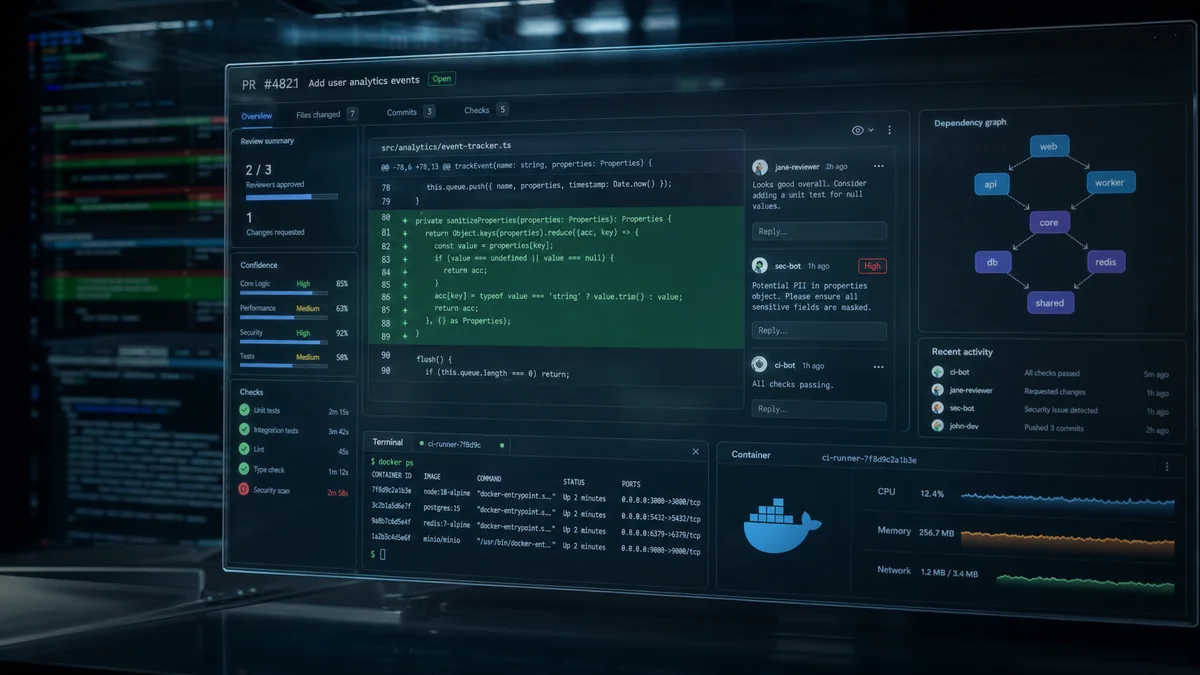
Mira is a "self-hosted AI code reviewer" available as open source, according to its repository README and FEATURES documentation. Its advertised capabilities include index-backed reviews that provide full-codebase context, CVE/OSV vulnerability scanning, organization-wide package search, dashboard telemetry, and a pipeline that automatically reviews PRs using user-provided LLM keys. The repository includes deployment Docker images, example configurations for Railway, Fly.io, and Render, SQLite and Postgres support, and per-repository settings through .mira.yaml.
Key points
- Deployment model: Self-hosted on local infrastructure or a cloud environment under the user's control. Mira runs as a GitHub App that receives PR webhooks and performs automated reviews.
- LLM integration: It uses OpenRouter by default to access commercial models from providers such as Anthropic, OpenAI, and Google, while direct integrations such as Bedrock are also documented. It is designed to point to self-hosted services such as vLLM and LocalAI.
- Data governance: The repository documentation makes the claim "Your code never leaves your infra" and states that code, embeddings, indexes, and review history are stored in a user-managed database, either SQLite or Postgres.
- Functional differentiators: It emphasizes operations-focused dashboard features such as an organization-level package inventory, CVE alerts through hourly OSV.dev polling, change blast radius from a dependency graph, and cost and token telemetry.
Why this matters in practice
- Organizations with data-governance and compliance requirements are often reluctant to expose review text and surrounding code to external SaaS products. Mira explicitly presents this concern as a differentiator.
- Model choice and cost accounting—tracking actual token usage and charges by model—make operational budget control easier.
Simple definition: A deployment model in which users operate a service directly on servers or infrastructure they control rather than through a third-party cloud service. Example: A company installs and operates a CI server such as Jenkins on its own virtual machine instead of using a SaaS product.
Simple definition: Large Language Model, a large neural-network model specialized in processing and generating natural language. Example: An LLM can automatically answer customer questions in a chatbot or generate code summaries.
Simple definition: The process of structuring and storing pieces of a codebase—such as tokens and embeddings—so that its contents can be searched and referenced. Example: It resembles building indexes by file and symbol so that function definitions can be found quickly in code.
Simple definition: CVE is a public vulnerability identifier from the Common Vulnerabilities and Exposures system, while OSV is an open-source vulnerability data source. Both are used to track package vulnerabilities. Example: When a library version contains a known vulnerability, it can be checked against OSV data to trigger an alert.
Deployment and operations checklist, based on the repository
- Permissions and webhooks
- The GitHub App requires Pull Requests (read and write), Contents (read and write), and Issues (read and write) permissions, along with PR and issue-comment events.
- Secret management
MIRA_GITHUB_PRIVATE_KEY,OPENROUTER_API_KEY, and any Bedrock or direct-endpoint credentials must be managed securely.
- Data store
- SQLite suits a single instance and quick startup, while Postgres offers better scalability and operational features such as backups, replication, and permissions.
- Model topology
- OpenRouter is the default, with options for direct Bedrock calls or locally hosted systems such as vLLM, Ollama, and LocalAI. Operations teams should evaluate the cost, latency, and data-use-policy trade-offs of each model.
- Filtering and noise control
- The documentation includes settings such as
confidence_thresholdandmax_commentsto control spammy or low-quality reports.
- The documentation includes settings such as
Benchmarks and caveats
The repository claims that "Mira is the fastest tool measured" and publishes comparisons using an offline subset of 50 PRs from the public Martian Code Review Bench, with Claude Sonnet 4.5 as the judge. Tables and charts are presented as support for the repository's claim.
Importantly, this article summarizes public repository material including the README, FEATURES document, and benchmark charts. Additional metadata such as the full measurement environment, sample-size considerations, and details of the automated evaluation using Claude Sonnet 4.5 are not comprehensively disclosed, so this article clearly attributes the claim to the repository.
Quick start, summarized
- Create a GitHub App: Configure the webhook URL and permissions, then issue a private key in
.pemformat. - Configure the default model, filters, and review behavior using environment variables in
.envandmira.yaml. - Deploy with the Docker image or begin with one of the example Railway, Fly.io, or Render configurations.
The following visual material includes deployment buttons and dashboard snapshots from the repository, along with explanations of why each image matters.
The documentation badge points to the official external documentation at docs.miracode.ai. Operational and configuration details such as the mira.yaml schema and custom-endpoint settings must be checked there, so the badge serves as an entry point to the documentation.

The dashboard screenshot visualizes the product's emphasized "organization-level signals," including package inventory, CVE alerts, and token and cost telemetry. It is useful for judging which metrics and detection workflows are visible from an operations perspective.
The deployment-button image indicates that a quick click-to-deploy path is available. It allows small teams or proof-of-concept environments to set up the system quickly and validate internal policy and performance.
Recommended operational practices
- Store secrets and model keys in a centralized secret manager such as AWS Secrets Manager or HashiCorp Vault and rotate them regularly.
- Aggregate token and cost telemetry by model and repository to detect anomalous traffic early.
- Establish a retention policy for embedding indexes, such as automatic expiration of old indexes, and configure rules to prevent sensitive data from being indexed.
- Monitor review-comment quality and apply a learning loop, such as generating rules from rejections, using human-in-the-loop feedback.
Conclusion and recommendations
Mira is an attractive starting point for teams seeking self-hosted code-review automation. It is particularly useful where data residency, cost control, and visibility into organization-level signals such as package inventories and CVEs matter. Because its benchmark and performance claims rely on public repository material, teams should revalidate them against their own workloads by running internal benchmarks.
Note: This article is based on the public README, FEATURES documentation, and release notes at https://github.com/miracodeai/mira. Consult the repository's internal documentation, including docs.miracode.ai, for the latest configuration and security recommendations.
Sources
- Search code, repositories, users, issues, pull requests... — license:
Apache-2.0, retrieved:2026-07-06. - Image: AI-generated cover image via OpenRouter — license:
ai-generated-original.