prompts.chat Analysis: An Open-Source Prompt Library with Self-Hosting Options

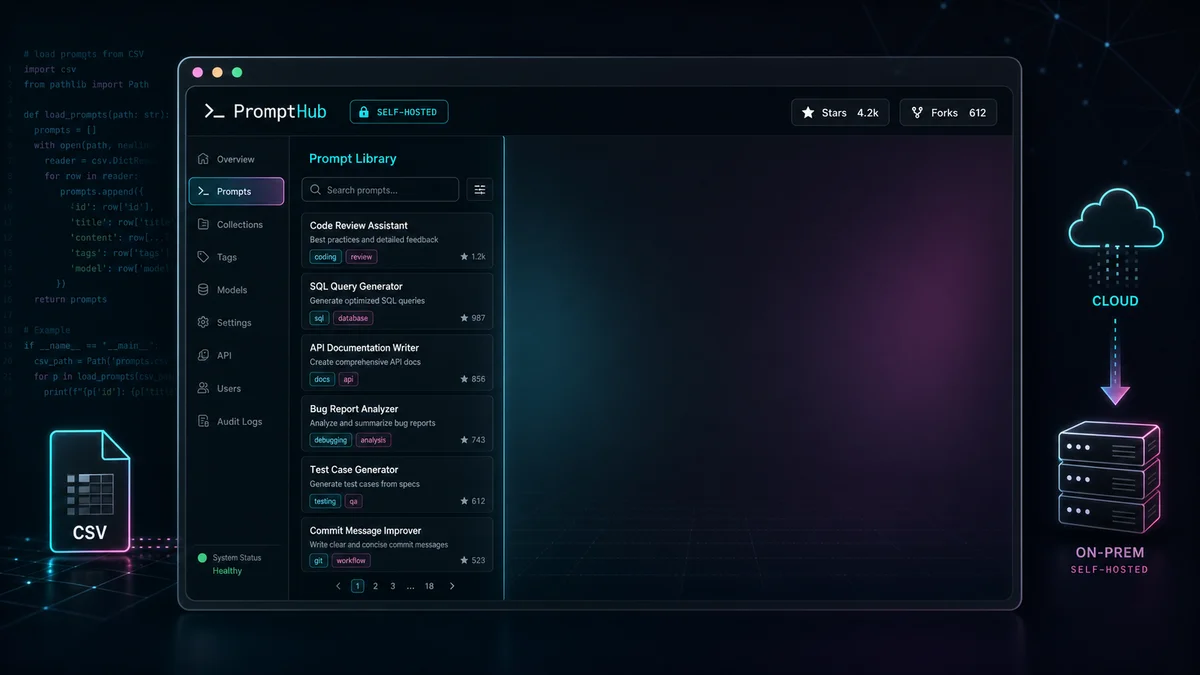
prompts.chat is a community-contributed prompt collection distributed through the f/prompts.chat GitHub repository and a separate web interface at prompts.chat. This article summarizes and interprets its features, licenses, deployment options, and integration points based on the supplied GitHub repository snapshot, including README, SELF-HOSTING.md, PROMPTS.md, and portions of related pages. It prioritizes facts confirmed in the documentation and explicitly marks some implementation details as uncertain when they are absent from the supplied evidence.
Summary of Key Evidence
- Character: a community-based open-source prompt library containing documentation and datasets. The repository includes README, PROMPTS.md, prompts.csv, and SELF-HOSTING.md.
- Visibility: high adoption indicators are presented on GitHub, including more than 165k stars and 21.3k forks according to the evidence.
- Licenses: the repository states a dual-license structure. Source code and site assets use MIT, while the prompts themselves, as data, use CC0-1.0 and are placed in the public domain.
- Deployment and self-hosting: official self-hosting documentation provides installation guidance through an
npxcommand or Git clone and npm installation, along with recommendations to use PostgreSQL and Neon as a hosting option. - Integrations: instructions include examples for connecting external AI tools through a Claude plugin and remote or local MCP server configurations.
These points summarize content stated in repository documentation including README, SELF-HOSTING.md, DOCKER.md, and CLAUDE-PLUGIN.md. Some operational and scaling details, including authorization models for large organizations and the full prompt-metadata schema, are not sufficiently visible in the evidence and are marked as uncertain below.
Structure and Deployment Model
The prompts.chat repository's file list and documentation structure—README, PROMPTS.md, prompts.csv, SELF-HOSTING.md, and DOCKER.md—suggest a hybrid repository that manages code and prompt data together. The recommended quick-start procedure is presented in the documentation as follows:
npx prompts.chat new my-prompt-library
cd my-prompt-library
Alternatively:
git clone https://github.com/f/prompts.chat.git
cd prompts.chat
npm install && npm run setup
According to the documentation, the setup wizard configures branding, themes, authentication through GitHub, Google, or Azure AD, and major features. PostgreSQL is specified as the recommended database, with Neon recommended as a hosting option.
Plain definition: a repository that collects and classifies the text used when communicating with AI, making prompts easy to reuse. Example: it resembles a collection of AI response templates for customer support that a company stores and shares among team members.
Integration Points and Extensibility
Main integration points visible in the documentation:
- Claude plugin: an example installs the plugin from a plugin marketplace, with separate plugin documentation.
- MCP server: examples configure prompts.chat as an MCP server through a remote URL or local command, allowing external tools to centrally query and manage prompts.
Plain definition: an abbreviation for the concept of a "modular content/plugin server," an interface that lets external applications remotely query prompts or plugin lists, based on the documentation's terminology and examples. Example: it resembles an internal configuration server with an API that several company services use to retrieve shared settings.
Caution: the repository documentation does not include the complete MCP specification or details of its authentication model. Security and authorization design for production requires separate review.
License and Data-Use Terms
The license policy stated in the documentation can be summarized as:
- Source code and site assets: MIT License
- Prompt content, or data: CC0 1.0, dedicated to the public domain
Plain definition: a permission that waives copyright or dedicates a work to the public domain so anyone can use it without restriction. Example: it resembles releasing free background music without copyright restrictions so anyone can freely use it in a video.
This structure permits prompt data to be reused and redistributed very generously. In actual operation, however, a separate policy is needed to inspect user-submitted prompts for personal and sensitive information. The supplied evidence does not include details of content-review or de-identification processes, so practical adoption requires further compliance review.
Self-Hosting — Strengths and Weaknesses
The documentation includes a self-hosting guide and Docker instructions. Its quick-start examples are simple and assume authentication through external OAuth providers and a database connection, with PostgreSQL recommended, as basic components.
Strengths based on the documentation:
- Privacy: prompts and user data can be managed within the organization through self-hosting
- Customization: branding, themes, and authentication are provided
- Integration: interfaces connect to external tools through MCP and plugins
Constraints and uncertainty:
- Documentation lacks details on operational scaling, backup and restoration strategy, and multitenancy support. Large production deployments require additional design.
Plain definition: installing and operating software directly on an organization's own infrastructure, or managed instance, without depending on an external service. Example: it resembles operating company email on an internal mail server instead of Gmail.
Statistics and Social Proof Stated in the Documentation
Public indicators presented in the documentation summary include:
- GitHub stars: more than 165k, according to the documentation
- Forks: 21.3k
- Academic citations: more than 40, with citation links in the documentation
These indicators can help assess community recognition, but the documentation does not include actual usage rates, active-contributor counts, or statistics from real deployment environments.
Security and Operational Considerations
The file list shows SECURITY.md and related files. The supplied evidence, however, does not provide detailed vulnerability-response procedures, secret management, or separation-of-permission design. The following items require review before operation:
- Whether user-submitted prompts contain personally identifiable information (PII), and the automated filtering and review process
- Permission scope when configuring authentication providers such as GitHub, Google, and Azure AD
- Risk of remote code execution or exposure of sensitive endpoints through MCP and plugin integrations
Plain definition: a permissive license that allows software to be copied, modified, and distributed with few restrictions, while requiring preservation of the copyright notice. Example: an open-source library can generally be included in your own service as long as its license notice is retained.
Images and Materials from the Source
The images below are some of the badges and logos provided in the repository README and web page. Each image can identify a project source or connection point, or act as a visual trust signal for external links such as the Hugging Face dataset and website.
This logo represents the official prompts.chat website and visually confirms that the repository and web interface share the same source.
This badge provides quick access to the project site and connects browsing and data points presented by the documentation, including prompts.csv, PROMPTS.md, and the Hugging Face link.
This image points to "Prompting for Kids," an interactive guide for children, suggesting that the project includes educational materials beyond the dataset itself.
(Note: the URLs for the images above are retained exactly as they appear in the source.)
Conclusion and Adoption Recommendations
prompts.chat is a large, community-contributed prompt collection distinguished by publishing prompt data under CC0 and providing a self-hosting guide. Organizations operating an internal prompt library should:
- Perform legal and compliance review: even for data published under CC0, review privacy and copyright concerns in user submissions.
- Design security: inspect authentication, separation of permissions, and remote-code-execution risk in MCP and plugin integrations.
- Plan operations: separately design scaling, backup, and monitoring policies because the documentation lacks detailed guidance.
- Customize through a proof of concept: the repository's branding and authentication options are favorable for a quick proof of concept, so validate integration scenarios internally first.
Finally, this analysis is based on the supplied public documentation and page snapshots from the GitHub repository. Runtime behavior, actual deployment telemetry, or the latest repository updates may not be included in this evidence. Check the latest repository and documentation directly before practical adoption.
Sources
- f/prompts.chat (GitHub repository) — license:
MIT; CC0-1.0, retrieved:2026-07-06. - Image: AI-generated cover image via OpenRouter — license:
ai-generated-original.