AISBF — Operating an OpenAI-Compatible Router and Local CoderAI Workers

AISBF is a lightweight control plane centered on an "OpenAI-compatible gateway" that combines multi-provider routing, local GPU workers called CoderAI, rotation and failover paths, and privacy and policy controls. This post provides a technical summary of features and operational considerations visible in the public demo and documentation at aisbf.cloud. Because the source does not clearly provide specific design or performance figures, the analysis marks uncertain areas.
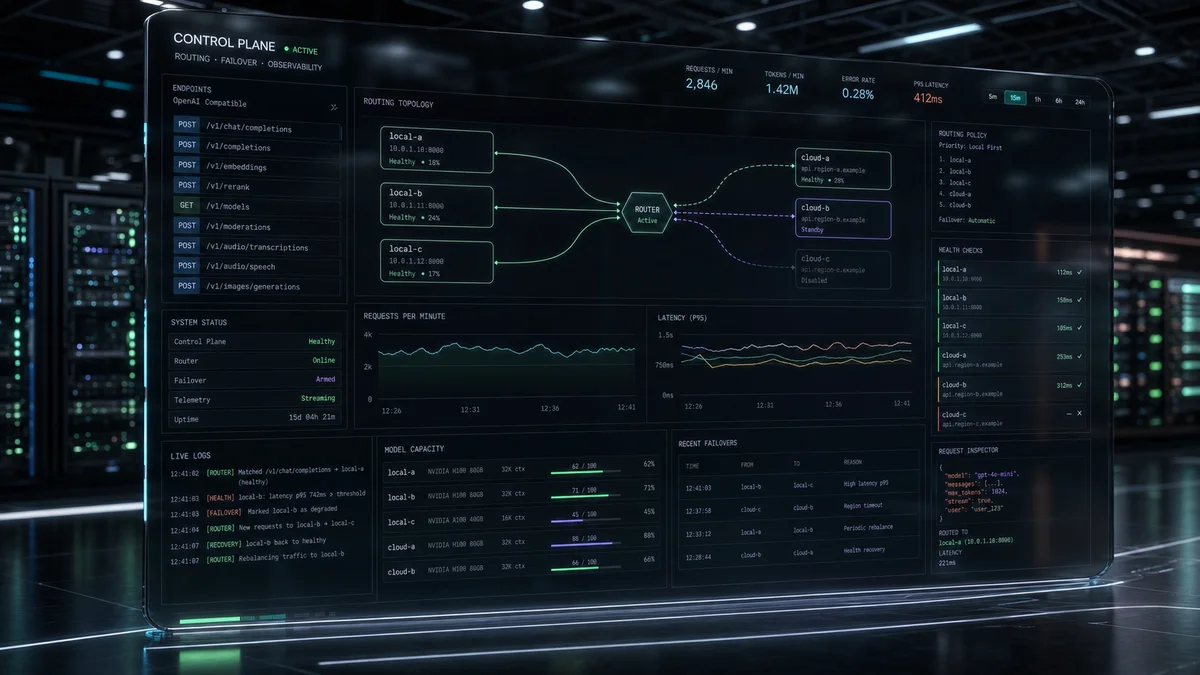
Key points:
- AISBF is a control plane designed to let applications call a variety of LLM and multimodal backends—including commercial clouds, self-hosted models, and local CoderAI—through one OpenAI-compatible interface.
- Its main value proposition is routing policy informed by prompts and context, resilience through failover and rotations, cost- and privacy-based selection, and exposure of local workers in broker mode.
- The public documentation states that it provides installation instructions for the Python package and CoderAI Docker bundle, hosted and self-hosted options, tutorials, and operational guides for production installation and failover configuration.
Design observations
- Benefits of a single OpenAI-compatible interface
- Applications can reduce code complexity by abstracting differences between provider SDKs.
- AISBF can centralize the policy and routing layer, applying privacy rules such as local-first processing, cost optimization, and resilience rules consistently.
- Local worker (CoderAI) integration
- CoderAI exposes a local GPU machine through an OpenAI-compatible API for local and private workloads.
- A WSS connection to AISBF in broker mode allows nodes behind NAT to join the worker pool securely.
- Operational and reliability patterns
- Rotation and fallback rules provide automatic alternate paths when a backend is slow or fails.
- Built-in context condensation can apply strategies that summarize or split long conversations and prompts to fit model input limits.
Operational guide, summarized from the documentation
- Installation: the documentation says that the local dashboard can be launched after installing AISBF from PyPI and directs users to install CoderAI through the provided Docker bundle. The source includes installation commands and examples.
- Hosted versus self-hosted: the hosted path is for quick trials, while self-hosting is recommended for privacy and control. It states that the source remains open source.
- Pricing and support: the documentation lists a low-cost Pro subscription during early development, at €6 per month or €60 per year, for hosted access and development support.
Limitations and uncertainties
- The public site provides architecture and feature lists and tutorials, but not performance benchmarks under high concurrency, security-audit results, or long-term operating-cost analysis. An internal benchmark and security review are therefore required before a large production rollout.
- The source alone does not fully reveal the exact prompt classification used for routing—which signals select each backend—or implementation details of the policy engine, such as the policy language and execution point.
Practical considerations before adoption
- Authentication and authorization: AISBF is documented as providing user- and project-scoped keys and quotas, but verify key management and rotation and support for identity providers such as OIDC.
- Auditing and logging: if some workloads must keep sensitive data local, verify that logging and audit settings meet privacy requirements.
- Network boundary: even though broker mode supports workers behind NAT, verify how upstream encryption and authentication mechanisms such as mTLS or tokens are applied.
- Cost and resilience testing: simulate routing rules and failover to measure cost trends and response latency.
Recommended experiments for quick validation
- Connect a local CoderAI instance to the AISBF hosted demo, create a private routing path, and test simple prompt-specific routing rules.
- Verify that failover behaves as expected under network-disconnection conditions and use logs to identify failure causes.
- Test context-condensation settings on chat histories of varying lengths to measure model cost and quality trade-offs.
Term explainers
Plain definition: an intermediate layer that imitates the OpenAI API's endpoints and input/output specification so that multiple providers can be called through one consistent interface. Example: when an internal system uses several models, such as OpenAI, Anthropic, and a local model, it acts as a proxy that lets all of them be called through the same API.
Plain definition: rules that send a request to a destination model or provider, plus automation that selects an alternate destination when the first one fails. Example: if the first provider is slow to respond, the system automatically sends the request to a second provider and returns that result.
Plain definition: worker software documented as exposing a local GPU machine through an OpenAI-compatible API and supporting multimodal generation including text, images, and audio. Example: to generate chatbot responses on a personal workstation's GPU, run CoderAI and register it with AISBF.
Plain definition: a mode in which a worker behind NAT or a firewall uses an outbound connection to reach a central control plane and receive work, without opening an inbound port. Example: broker mode lets a home computer join the work pool through AISBF without exposing a public port.
Plain definition: a collection of strategies that summarize a long conversation or document, or select only its essential parts, to fit the model's input-token limit. Example: reducing a 10,000-token conversation to no more than 2,000 tokens and sending only the latest state to the model.
Conclusion
AISBF offers a practical approach to managing routing, privacy, and local-worker integration in a multi-provider environment through one control plane. Its public documentation and tutorials provide a starting point for installation and operation, but large-scale use requires separate performance and security validation. If you are considering adoption, follow the documented installation, failover, and broker tutorials to build a small prototype, then assess risk through authentication, audit, and load testing.
Sources
- AISBF — license:
unknown, retrieved:2026-07-06. - Image: AI-generated cover image via OpenRouter — license:
ai-generated-original.