AgentsCAD: Automated Design for Manufacturing of FDM Parts — Multi-Agent LLM Reasoning and Geometric Feature Recognition

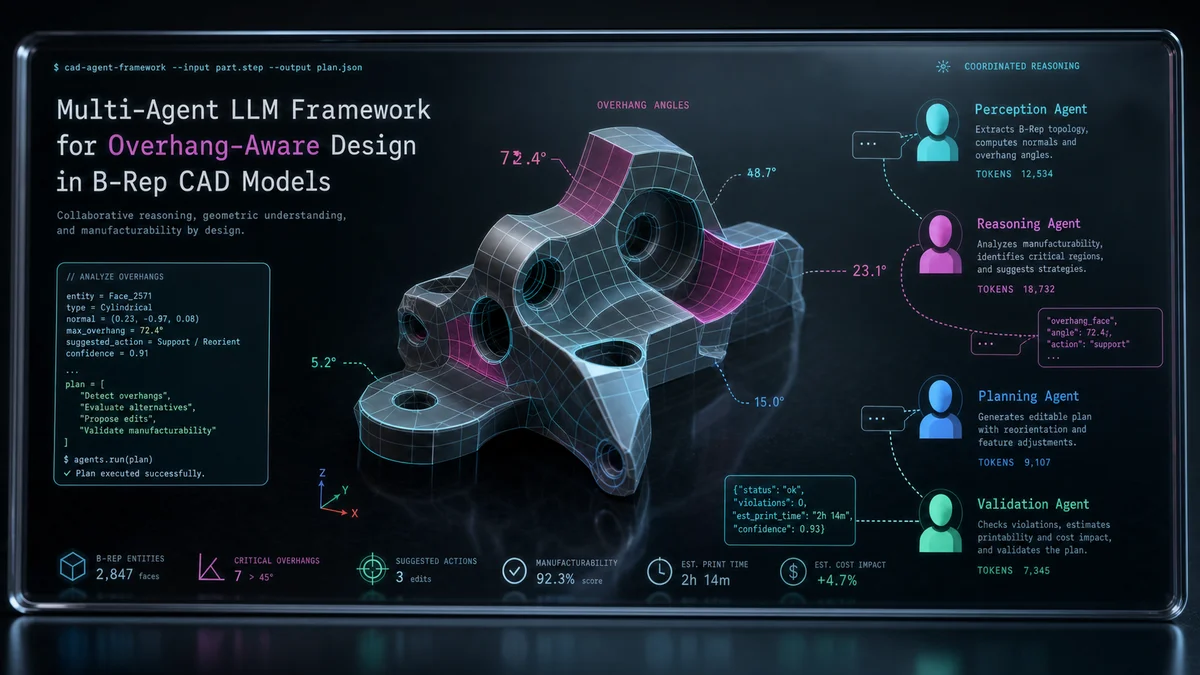
AgentsCAD proposes a pipeline that combines geometric feature recognition with multi-agent LLM reasoning agents to automatically diagnose design-for-manufacturing (DFAM) requirements for Fused Deposition Modeling (FDM) parts and generate modification recommendations. Based on the arXiv abstract and public metadata, this post provides a technical summary of the system architecture, core techniques, and the birdhouse example described in the paper, while clearly marking details that cannot be verified from the available evidence.
Summary — Core Components Reported in the Paper
The AgentsCAD pipeline, summarized from the abstract, consists of the following stages:
- Input: parse a B-Rep (boundary representation) model from a STEP file.
- Defect detection: detect overhangs of 45° or greater.
- Topology construction: build a face-adjacency topology graph.
- Optional semantic label injection: annotate the graph with semantic geometric features predicted by a GraphSAGE model trained on MFCAD++ (approximately 59,665 parts).
- Design reasoning: a design-reasoning agent based on Claude Sonnet generates modification recommendations such as reorientation, fillets, and chamfers.
- Verification: a GPT-4o vision-language verifier inspects rendered views to confirm geometric integrity.
- Output: a modified STEP file and a human-readable report.
According to the abstract, in a test on a birdhouse model the system was partially successful at diagnosing overhangs, selecting defect-mitigation strategies, and proposing physically plausible modifications.
Technical Commentary
- Input data and representation
- STEP / B-Rep: the paper states that it parses STEP files and uses B-Rep (boundary representation) information. Because B-Rep directly represents faces, boundaries, and vertices, it is better suited than a simple mesh to continuous geometric operations such as fillet computation and face-adjacency inspection.
Plain definition: a CAD representation that describes an object's surface in terms of faces, edges, and vertices. Everyday example: it is like defining every face and edge separately when folding a paper model into the shape of a house.
- Overhang detection and physical constraints
- AgentsCAD diagnoses overhangs using a 45° threshold, as stated in the abstract. This is related to the need for support structures in FDM printing.
- The abstract reports that the system proposes suitable mitigation strategies such as reorientation, fillets, and chamfers. It does not, however, provide quantitative evidence that every proposed modification was validated against printer-specific process variables such as material, temperature, and geometric tolerances. Physical print tests and parameter tuning are therefore required before use in the field.
Plain definition: geometry in which a new layer extends beyond a certain angle without support from the layer below during printing. Everyday example: it resembles leaving a plate hanging halfway off a table, with nothing supporting the exposed underside.
- Graph-based geometric topology and GraphSAGE
- AgentsCAD constructs a face-adjacency graph and uses its topology. This graph structure serves as a useful intermediate representation when combining geometric relationships—such as which faces touch—with an LLM.
- The abstract states that GraphSAGE is trained on the MFCAD++ dataset of 59,665 parts and injects semantic feature labels. This appears intended to supplement semantic information that traditional geometric algorithms have difficulty capturing.
Plain definition: a method for learning graph-node embeddings by sampling and aggregating the features of neighboring nodes to construct each node's representation. Everyday example: it is like predicting a friend's food preferences by consulting a sample of their friends' tastes and aggregating that neighboring information.
- Multi-agent LLM reasoning and the verification loop
- The main differentiator is the use of a multi-agent LLM system to translate between geometry and language. The abstract reports using Claude Sonnet as the design-reasoning agent and GPT-4o as the vision-language verifier.
- This combination forms a loop that (1) describes structural defects in language, (2) converts language instructions back into geometric modification proposals, and (3) uses rendering-based inspection to verify the integrity of the modifications.
Plain definition: a neural-network model trained on large volumes of text to generate and understand language. Everyday example: think of it as a highly automated writing assistant that has read many books and documents and can produce human-like sentences.
- Outputs and human-readable reports
- The abstract states that the system outputs a modified STEP file and a human-readable report. This is a practical arrangement that combines automation with the ability for a designer to review the result and make manual adjustments.
Application and Validation Scope — An Evidence-Based Interpretation
The abstract briefly reports results from testing on a birdhouse model. Specifically, it says that "the system accurately diagnosed overhangs, selected suitable mitigation strategies, and proposed physically plausible modifications." The following uncertainties remain:
- The abstract does not include quantitative performance metrics such as accuracy or false-positive and false-negative rates, actual print success rates, or improvement in mechanical strength after modification.
- The available metadata does not reveal details of GraphSAGE training such as hyperparameters, accuracy, and validation splits, nor implementation details of the LLM agents' prompting or chain of steps.
This post is therefore a summary and analysis based on the paper's abstract and page metadata. Reproducing the implementation or applying it in production requires consulting the full paper and any code or data released by the authors.
Practical Implications and Limitations
- Significance: AgentsCAD is a meaningful attempt to bridge the gap between design and manufacturing by combining CAD's structural representation, B-Rep, with an LLM's natural-language reasoning. Combining topology graphs with machine-learning-based semantic labels can give the LLM more accurate context for its recommendations.
- Limitation: an abstract-level report is insufficient to assess experimental reproducibility, including parameters, data preprocessing, and rendering-pipeline configuration. Successful FDM output depends on many process parameters such as material, printer settings, and support strategy, so field experiments are essential.
Conclusion and Recommended Resources
AgentsCAD is an interesting approach to automating DFAM work by connecting geometric feature recognition with multi-agent LLMs. For deeper technical reproduction, I recommend the following:
- Review the full paper to verify the experimental procedure, hyperparameters, and dataset details; the abstract alone is insufficient.
- If the authors have released code, models, or data, reproduce and validate the end-to-end pipeline on a simple case similar to the birdhouse.
- To evaluate the effect of the proposed modifications on actual FDM output, perform physical inspection after printing, including dimensional accuracy, mechanical strength, and surface quality.
Note: this post was written from the arXiv abstract and public metadata. Consult the original PDF and materials provided by the authors for the full text and implementation details.
Sources
- AgentsCAD: Automated Design for Manufacturing of FDM Parts via Multi-Agent LLM Reasoning and Geometric Feature Recognition — license:
CC BY 4.0, retrieved:2026-07-06. - Image: AI-generated cover image via OpenRouter — license:
ai-generated-original.